The Immortal 8-Bit Chip — Selling for 48 Years Without Cache or Branch Prediction
Born in 1976, the Z80 architecture remained in continuous commercial production across an entire product family for 48 years. By trading raw benchmark pursuit for a single 5V rail and on-chip DRAM refresh, it slashed system BOM costs; by offering absolute cycle determinism, it became an irreplaceabl

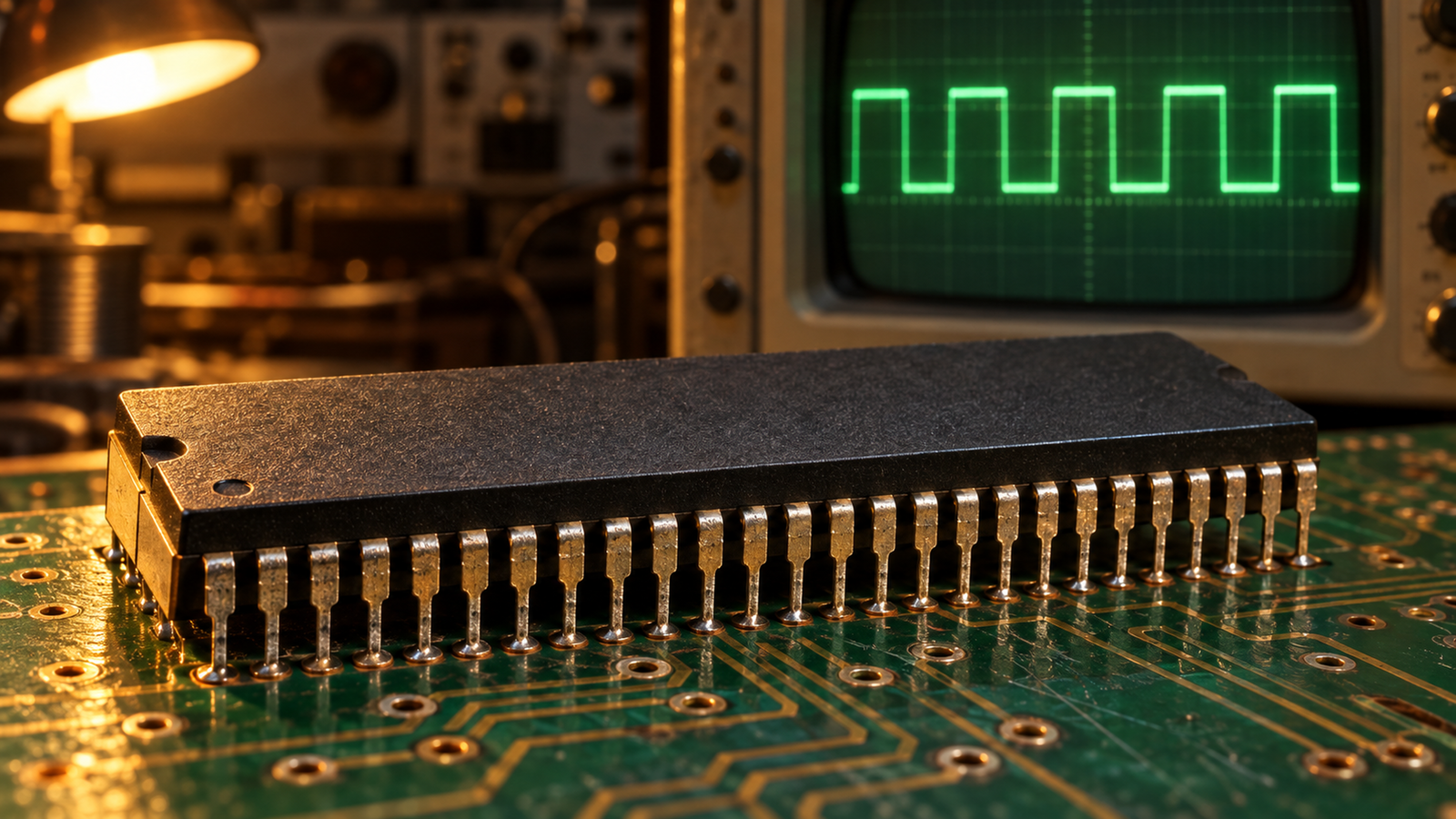
Why the industrial world spent half a century failing to replace a 1976 microprocessor
On April 15, 2024, Zilog issued a Product Change Notification (PCN).
The reasoning was straightforward: its wafer foundry manufacturer was discontinuing support for legacy product lines. Classic standalone CPUs in the Z84C00 series and their peripheral companions entered their final procurement window, with order acceptance ending permanently on June 14, 2024.
In an era dominated by trillion-parameter artificial intelligence models and sub-nanometer GPUs, few noticed an end-of-life notice for an ancient 8-bit chip. Yet for hardware engineers and industrial technicians around the world, it marked the conclusion of a remarkable chapter:
Across decades of semiconductor upheaval, the Z80 architecture and its derivatives remained in continuous commercial production as an entire product family for 48 years.

Microprocessor pioneer Federico Faggin with integrated circuit blueprints. Source: Wikimedia Commons, Photograph: Federico Faggin, License: CC BY-SA 2.0
Gordon Moore’s early observation suggested semiconductor integration density doubled roughly every two years. Thousands of processors with higher clocks and more complex microarchitectures were introduced, peaked, and were quietly discarded as processes migrated.
From the original 1976 NMOS silicon featuring 8,500 transistors (clocked between 2.5 MHz and 4 MHz) to later CMOS revisions operating at 20 MHz (the Z84C00 series), the fundamental instruction set and register model remained intact. What kept it viable on factory floors for nearly half a century was never peak calculation speed, but a collection of pragmatic decisions that saved system designers real money.
The Cost of a Dozen Peripheral Chips
Evaluating contemporary processors typically centers on pipeline depth, cache hierarchy, and synthetic benchmarks. In the mid-1970s, hardware engineers evaluated a processor by the bill of materials (BOM) required to make it operate on a printed circuit board.
When Intel introduced the 8080 in 1974, it launched the personal microcomputer era. Yet integrating it onto a board demanded significant electrical acrobatics.
The 8080 required three separate power supplies: +5V, -5V, and +12V. Board routing was cumbersome, and operation required pairing the CPU with an external 8224 clock generator and an 8228 bus controller.

Intel 8080 8-bit microprocessor. Source: Wikimedia Commons, Photograph: Christian Bassow, License: CC BY-SA 4.0
Worse, newly popular dynamic random-access memory (DRAM) chips required row address strobes every few milliseconds to prevent stored charge from leaking away. The 8080 offered zero on-chip refresh assistance. Designers had to assemble a sprawling array of discrete TTL logic gates or purchase costly specialized refresh controllers. The supporting circuitry frequently exceeded the cost of the central processor itself.

Zilog Z80 8-bit microprocessor in its classic DIP-40 package. Source: Wikimedia Commons, Photograph: Gennadiy Shvets (CPU-World), License: CC BY 2.5
Federico Faggin, who had led the physical design of both the 4004 and the 8080 at Intel, understood these engineering pain points deeply. At the time, Intel management focused primarily on semiconductor memory, viewing microprocessors largely as vehicles to drive memory sales. In late 1974, Faggin departed Intel to co-found Zilog alongside Masatoshi Shima, determined to design a processor that minimized peripheral complexity. Faggin led Zilog until late 1980, later co-founding capacitive touch pioneer Synaptics in 1986.
Faggin and Shima eliminated the 8080's operational overhead.
They engineered the Z80 to run entirely on a single +5V power rail, driven by a standard single-phase clock input, eliminating dedicated power conditioning components.
Their most impactful innovation lay in on-chip dynamic memory refresh. Faggin integrated a dedicated 7-bit R register directly onto the silicon and routed an active-low /RFSH pin to the outside world.
During the M1 machine cycle of every instruction fetch, the first two clock periods read the operational code. During clock cycles T3 and T4, while the internal execution unit decoded the instruction, the external address bus sat completely idle. The Z80 exploited this quiet window to place the R register's contents onto the address lines as a row address, asserting /RFSH to refresh dynamic RAM, and automatically incrementing R.
The processor never stalled, and the system eliminated the external TTL refresh circuitry.
When Zilog introduced the Z80 in 1976, it cost around $25 at volume. Beyond competitive pricing, eliminating secondary power supplies and external refresh chips drastically lowered the threshold for building an operational microcomputer.
Clive Sinclair built the mass-market ZX Spectrum in Britain around the chip, while RadioShack adopted it for the TRS-80. Personal computing entered living rooms largely because the Z80 stripped peripheral hardware requirements down to the bare essentials.

Sinclair ZX Spectrum 48K home computer powered by the Z80. Source: Wikimedia Commons, Photograph: Sintegrity, License: CC BY-SA 4.0

RadioShack TRS-80 Model I personal computer based on the Z80. Source: Wikimedia Commons, Photograph: Binarysequence, License: CC BY-SA 4.0
Assembly Code Running for Thirty Years
Low hardware cost alone could not shield a chip against subsequent architectural shifts. The mechanism that permanently embedded the Z80 into industrial infrastructure was the immense sunk cost of software.
Faggin designed the Z80 with strict binary backward compatibility with the Intel 8080. Existing CP/M operating systems, compilers, and commercial tools ran on the Z80 without modifying a single instruction, providing an extensive software library on arrival.
Consumer electronics followed:
In 1980, Namco's global arcade sensation Pac-Man ran its primary game logic on a single Z80. In 1989, Nintendo selected a customized Sharp core derived from the Z80 for the original Game Boy, eventually selling over 118 million units. Texas Instruments built generations of educational graphing calculators, including early models of the TI-83 and TI-84, around Z80 cores.

Pac-Man replica cabinet (modern Arcade1Up model); a single Z80 powered the original 1980 Namco arcade game. Source: Wikimedia Commons, Photograph: YosemiteYamper, License: CC BY-SA 4.0

Nintendo Game Boy handheld console powered by a customized Sharp Z80 core (LR35902). Source: Wikimedia Commons, Photograph: Evan-Amos, License: Public domain

Classic Texas Instruments TI-83 Plus graphing calculator. Source: Wikimedia Commons, Photograph: Hannes Grobe, License: CC BY-SA 3.0
Beyond consumer goods, the Z80 embedded itself into industrial automation. In 1978, Pro-Log and Mostek jointly developed the STD Bus standard, adopting the Z80 as a primary 8-bit platform for factory process control and automated test instrumentation.
In industrial plants, economics follow an unforgiving logic: when an automation controller has operated without failure for thirty years, replacing it is financially punitive. Upgrading to a modern 32-bit microcontroller adds trivial silicon cost, but forces an enterprise to reverse-engineer legacy assembly, construct new hardware test benches, and recertify specialized safety compliance. That process routinely demands years of engineering labor and millions of dollars.
When Zilog issued its April 2024 end-of-life notice, it set the final order deadline for June 14 while scheduling a 24-week final manufacturing run. In semiconductor operations, reserving months of manufacturing capacity typically reflects industrial customers building lifetime buffer inventories.
Software does not rot. As long as established assembly code executes faithfully, few chief engineers will risk plant shutdowns to replace a functioning Z80 controller board.
The Determinism of Four Clock Cycles
If software inertia provided industrial stability, an ancient architectural property granted the Z80 its ultimate refuge: absolute timing determinism.
Modern microprocessors prioritize average computational throughput by stacking multi-level caches, speculative execution units, instruction pipelines, and out-of-order execution engines. Clock frequencies advanced from megahertz to gigahertz, but the duration of any single instruction turned into a statistical probability.
A cache miss or branch misprediction introduces timing jitter spanning dozens of clock periods.
While streaming video or rendering a web page on a personal computer, microsecond latency fluctuations are invisible. Inside a real-time industrial feedback loop, however, timing jitter during valve modulation or motor position sampling can cause physical systems to oscillate out of control.
The Z80 never depended solely on Zilog's fortunes.
Its 1976 technical manual printed exactly how many clock cycles an instruction takes in black and white, and that number remained constant across generations.
Its register file was similarly architected for deterministic interrupt handling. Alongside standard working registers, the silicon housed an internal shadow register bank (AF', BC', DE', and HL').
Standard microprocessors handled external interrupts by pushing active register states onto memory stacks. On the Z80, an interrupt routine could execute two single-byte instructions—EX AF, AF' and EXX—swapping the entire register context inside the execution core in exactly four clock cycles, without touching external system bus memory.
In mission-critical industrial control, cycle-accurate predictability often matters far more than theoretical peak clock speed.
When the Vendor Retires, the Community Builds Silicon
The Z80 was never solely dependent on the fortunes of Zilog.
During the 1970s and 1980s, the semiconductor sector relied on second-source licensing to ensure procurement security. Zilog licensed its design and masks to Sharp, Toshiba, NEC, and Mostek. Although Zilog struggled during the transition to 16-bit architectures and the IBM PC expansion, this distributed manufacturing base insulated the Z80 from single-company risks for decades.
In April 2024, legacy foundry lines ceased operations, closing procurement for the Z84C00. On October 11, 2026, Hackaday reported that Littelfuse issued PCN ZAC26-0074, scheduling December 21 of that year as the final order date for the successor eZ80 microcontroller.
Yet when official fabrication ended, communities maintaining vintage computers and industrial systems refused to retire their hardware.
Under the z80-open-silicon initiative led by Renaldas Zioma, engineers adapted Guy Hutchison's open-source TV80 Verilog implementation to tape out physical silicon via the Tiny Tapeout 7 program on SkyWater's 130nm process.
This design, originally etched in 1976 using N-channel silicon-gate depletion-mode technology (NMOS), occupies just 0.064 square millimeters in modern 130nm lithography. Developers are currently testing adapter boards designed to plug these open-source chips directly into vintage backplanes still in active service.
The retirement notice for the Z84C00 marked the end of 48 years of continuous factory production overseen by its original creators. Yet while Moore's Law pushes lithography toward physical limits, the industrial world adheres to a simpler truth: processors that strip system BOM to the absolute minimum, preserve working code across decades, and guarantee the execution time of every clock cycle consistently outlive the sophisticated architectures built to replace them.