Why Great Coders Fail Interviews — And What Actually Gets You Hired
Great coding and great interviewing are different skill trees. Here’s the 70% that gets strong engineers rejected.
INTERVIEW
Why Great Coders Fail Interviews — And What Actually Gets You Hired
Last month, I rejected a candidate whose open-source project had over 2,000 GitHub stars.
I know how that sounds.
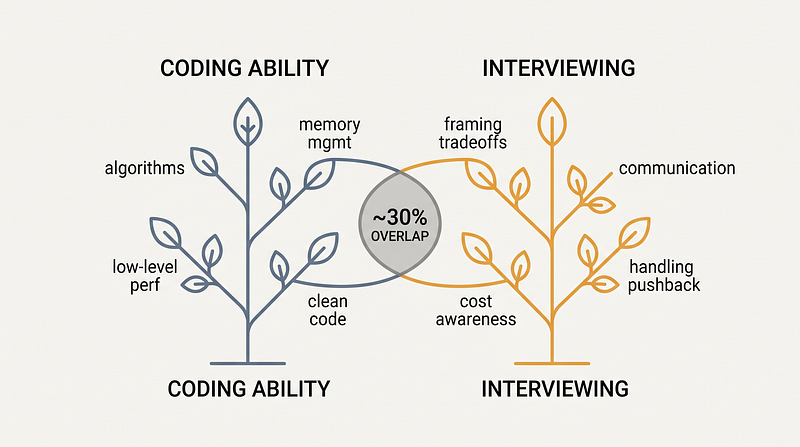
I’ve been in this industry for over a decade — from the early Hadoop era, through deep learning, to now, spending my days deep in LLM training pipelines. I’ve sat across the table from hundreds of engineers. And I can tell you with full confidence: being a great coder and being a great interviewee are two separate skill trees. The overlap is maybe 30%, if you’re lucky.
Let me skip the theory and tell you exactly where the traps are.
The Fundamental Misunderstanding About What Interviews Are For
Most people think an interview is like an exam. Score high, get hired.
It’s not.
An interview is a verification and negotiation process. When a company hires, the question underneath every round is: Can I sit next to this person for the next few years, trust their judgment under uncertainty, and not regret it?
The GitHub star guy had impressive code. I looked through his project — beautiful low-level C++ with surgical memory management.
But during the interview, he fixated on one implementation detail and stopped hearing what I was asking.
When I said, “If data volume scales to a billion records, how does your current architecture hold up?”
He told me, “Give me time, and I’ll rewrite a better low-level library.”
I wanted tradeoffs. I wanted a plan. Not a promise to rebuild from scratch.
1. Engineering Thinking vs. Problem-Solving Thinking
The best coders, especially the hacker types, love the clarity of machines. Input defined, logic defined, output defined. Beautiful.
But interviews, especially at the senior level, test how you handle ambiguity.
Here’s a question I’ve been asking a lot lately:
We’re training a 100-billion parameter LLM, and we’re running out of VRAM. Beyond just adding more GPUs, what are your algorithmic and engineering-level optimization strategies?
There’s no single right answer. People with a “solve the test” mindset either freeze or recite: “Mixed precision training. Gradient accumulation.”
That’s not enough.
What I want to hear is someone walking me through:
- Gradient Checkpointing — trading compute for memory by not storing all intermediate activations
- ZeRO (Zero Redundancy Optimizer) — specifically, which of the three stages cuts what: optimizer states, gradients, or model parameters
- CPU/NVMe Offloading — when you genuinely need to spill beyond GPU memory
The point isn’t that you memorized these. The point is that you can reason through a real constraint with me, out loud, in real time. That’s what I’m hiring for.
2. Depth Without Breadth
Tech stacks move fast. A few years ago, everyone was optimizing ResNets. Now it’s all Transformers.
Some engineers go deep in one niche (say, on-device model deployment or writing assembly-level optimizations) and emerge as incredible specialists. Then they sit down with me, and I ask: “What’s the principle behind KV Cache, and why does it speed up inference?”
Blank stare.
This isn’t a knock on their ability. It’s a version problem. They haven’t kept up with the current stack.
The short answer on KV Cache: in autoregressive generation, every new token attends over all previous tokens. The Key and Value matrices for those prior tokens never change, so caching them removes redundant computation. Simple in concept, massive in practice.
But if you haven’t read the relevant papers or traced through the source code, you can’t reconstruct this under pressure. And to the interviewer, that looks like weak fundamentals.
My recommendation: Follow the Hugging Face blog and Jay Alammar’s writing (his book The Illustrated Transformer). Don’t just bookmark them. Rebuild each diagram in your head. In the LLM era, understanding principles matters more than writing code, because the code can be generated. The principles can’t.
3. Over-Honesty Without Framing
Most engineers are honest people. Code runs, or it doesn’t. A bug is a bug.
That honesty, carried into interviews, is a disaster.
Interviewer: “What was the biggest challenge in your last project?”
Honest engineer: “Honestly, nothing too crazy. The data cleaning was a bit messy, so I wrote a script. We had some VRAM issues, so I reduced the batch size.”
That’s professional self-destruction. You just flattened every technical challenge you actually faced.
Here’s the same story, told properly:
“During data preprocessing, we faced heterogeneous source schemas and severe long-tail distribution in our training data, which caused convergence instability. I designed an automated cleaning pipeline that combines rule-based filtering and semantic matching and introduces Focal Loss to address class imbalance due to rare samples. On the training side, hardware constraints forced me to rethink our batch strategy — I ran experiments comparing gradient dynamics across batch sizes and implemented Gradient Accumulation to simulate large-batch training within our VRAM budget, recovering most of the performance without adding hardware.”
Same work. Same code. Completely different impression.
Learning to narrate your work isn’t spin. It’s a skill. The interviewer needs a signal to calibrate your level. Flatten everything into one sentence, and you give them nothing to work with.
4. Your Knowledge Has a Staleness Problem in the RAG Era
For those interviewing at AI/ML companies, here’s where I see the sharpest split.
Most candidates can describe a basic RAG pipeline: chunk documents, embed them, store them in a vector database, retrieve the top-K at query time, and stuff them into the context window. Fine. But the moment I go one layer deeper, things fall apart.
Some questions I ask:
- Your retrieval relevance scores look high, but the model still hallucinates. What’s your diagnosis and fix?
- How did you choose your chunk size? Why 512 and not 256? What does the overlap setting actually affect in terms of recall?
A surface-level RAG practitioner guesses. A strong candidate talks about:
- Dense Passage Retrieval (DPR) and its training dynamics
- The critical role of a Cross-Encoder reranker — yes, it adds latency, but ANN alone isn’t enough for factual precision
- When to blend sparse retrieval (BM25) with dense for better coverage
If you want to go deep on this, PracHub’s interview guide maps the RAG and LLM interview landscape by concept rather than dumping isolated Q&A. Worth going through before any senior ML or AI engineering interview.
5. Defensive Communication
Technical people often carry a healthy ego about their craft. In day-to-day work, that’s fine. It means you have standards.
In interviews, it’s a landmine.
I’ve watched candidates get defensive the moment I push back, red-faced, trying to prove me wrong. Or I drop a hint because they’re stuck, and they reject it outright and try to solve it the hard way, just to show they didn’t need my help.
Here’s what I’m actually testing when I challenge you:
- Stress response — how do you behave when you’re wrong in front of someone evaluating you?
- Collaborative instinct — can we build toward a solution together?
If we can’t reach alignment in a 45-minute interview, why would I believe we can collaborate on a six-month project with a PM who keeps changing the requirements?
The move, when challenged, is: “That’s an angle I hadn’t prioritized. If we weight maintenance cost more heavily than raw throughput, your approach is probably more defensible. Let me reconsider from that end.”
One sentence. Shows depth. Shows EQ.
6. Over-Engineering in System Design
This one catches senior engineers specifically.
Prompt: Design a URL shortener. Expected daily traffic: ~50,000 requests.
The response I got: Microservices. Twelve separate services. ZooKeeper for coordination. Kafka for event streaming. A Redis cluster. Sharded MySQL.
Me: A single MySQL instance on modest hardware handles millions of simple reads per day. Why are we bolting $40,000/month of infrastructure onto a 50K-request service?
Him: Scalability. High availability.
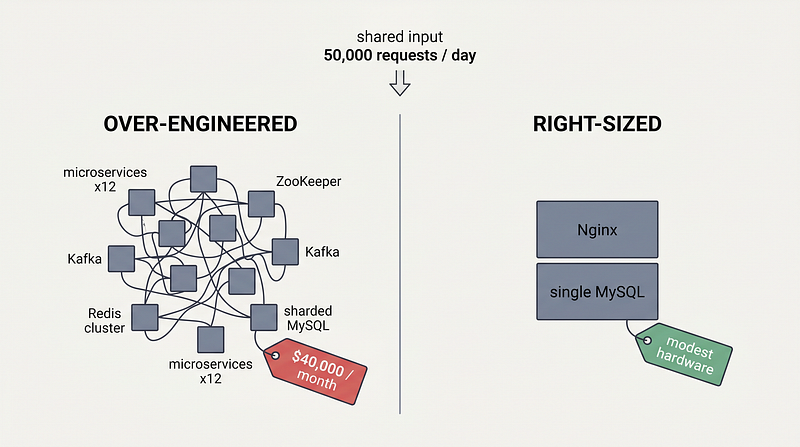
That’s engineering for engineering’s sake. Good architecture follows requirements. The right answer starts simply (a single instance, Nginx for load balancing), then walks through what you’d change if traffic grew 10x, 100x, or 1000x. That’s evolutionary architecture thinking.
If you want to sharpen this instinct, read Designing Data-Intensive Applications (DDIA). Not for implementation details, but for the mental framework of making tradeoffs in distributed systems. It’s the most important book in the field, and you should work through it alongside actual system design practice.
7. Your Resume Doesn’t Show the Work
If you write great code, why does your resume read like a job description?
Most resumes I see:
Proficient in Python and PyTorch. Experienced with recommendation systems. Contributed to core ML infrastructure.
That tells me nothing.
Here’s what it should look like:
Re-architected the training loop using FlashAttention, cutting VRAM consumption by 30% and training time by 40% on equivalent hardware.
Diagnosed and resolved a Redis hot-key deadlock under high concurrency; introduced a local L2 cache layer, dropping P99 latency from 500ms to 50ms.
Specific. Quantified. A visible problem and a visible fix.
If you have open-source projects, don’t just drop the link. Pick the one where you did the most technically meaningful work and explain what the hard part was. Your commit history is better evidence of coding ability than anything you could whiteboard. But only if you lead the interviewer there.
The Whiteboard Problem (And What to Do About It)
Many great engineers freeze on whiteboard coding. They’re used to autocomplete, Stack Overflow, debuggers, and Copilot. Stripped of those, they can’t reverse a linked list.
This isn’t a real measure of engineering ability. But it’s the game.
Accept it and prepare. No matter your seniority, grind LeetCode Hot 100 before any interview cycle. Don’t memorize solutions. Build templates. Understand what problem class each pattern addresses:
- Sliding window → continuous subarray problems
- Dynamic programming → optimal substructure, find the recurrence
- Two pointers → sorted arrays, palindromes, shrinking search space
Pattern recognition is a skill. The specific problem is just the vehicle.
For a more structured approach, PracHub organizes prep material beyond plain problem lists — it maps concepts to interview stages and common follow-up traps. Useful if you’d rather be systematic than grind randomly.
What You’re Actually Being Evaluated On
Interviewing is not one-dimensional. Picture the interviewer playing four roles at once:
- Compiler — can you write correct, working code?
- Product manager — do you understand the business context and constraints?
- CFO — do you have cost awareness? Do you know when simple is better?
- Therapist — can you communicate, take feedback, and collaborate under pressure?
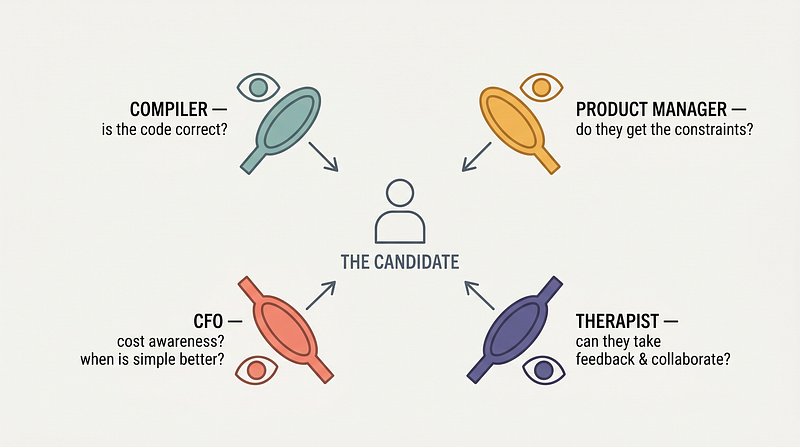
Code is the baseline. It gets you to the table. But what gets you the offer and keeps you progressing is the combination of all four.
Close your IDE before the interview. Take out a piece of paper. Draw your system architecture. Articulate the business value of the projects you’ve built. Read the foundational papers behind the techniques you use. Practice explaining a complex technical concept to someone non-technical.
When you can explain the why and how behind your code, not just the what, interviews start to feel easier than writing the code itself.
The hard part isn’t knowing the answer. It’s knowing how to show that you know.
If you’re actively preparing for ML/AI engineering interviews, the PracHub Interview Guide is one of the more structured resources I’ve found for covering LLM, RAG, and system design as a connected whole rather than isolated questions. Worth a look.