Why America Still Won’t Go Metric
A $327 million Mars probe, a jumbo jet that ran out of fuel at 41,000 feet, and $17 billion a year — the price of one country’s refusal to…
America
Why America Still Won’t Go Metric
A $327 million Mars probe, a jumbo jet that ran out of fuel at 41,000 feet, and $17 billion a year — the price of one country’s refusal to switch
Buy a can of Coke in the United States, and it holds 355 milliliters. Buy the same can in Canada, the UK, or China, and it holds 330 milliliters.
Nobody redesigned the recipe. The 25 ml gap is a rounding artifact: American cans are sized to an even 12 fluid ounces, and a fluid ounce is 29.57 ml, a unit hardly anyone else still uses to price drinks.

That one soda can is a small window into a much bigger fact. The United States is one of three countries in the world (alongside Liberia and Myanmar) that have never fully adopted the metric system. Everyone else measures in meters, liters, and Celsius. Americans measure in feet, gallons, and Fahrenheit, and have twice tried, formally, to change that. Both attempts collapsed.
In between, the mismatch has cost real money and, at least once, come very close to costing real lives.
A Body of Units, not a System
Imperial units weren’t designed. They accumulated, mostly from the human body. An inch was originally the width of a man’s thumb knuckle. A foot was, unsurprisingly, a foot. A mile traces back to mille passus, a thousand paces of a Roman soldier, each pace counted as two steps.
That made imperial units easy to use with nothing but your own body, which is exactly why they survived so long in agrarian societies. It also made them brutal to calculate with, because nothing about them is related by a clean base. Twelve inches to a foot. 5,280 feet to a mile. Sixteen ounces to a pound, 14 pounds to a stone. There’s no pattern to memorize. Every conversion is its own fact.
The metric system, designed in France in the 1790s, threw that out entirely and rebuilt from a single rule: everything scales by powers of ten. A meter is 10 decimeters, a decimeter is 10 centimeters. Converting between units is moving a decimal point, not consulting a lookup table.
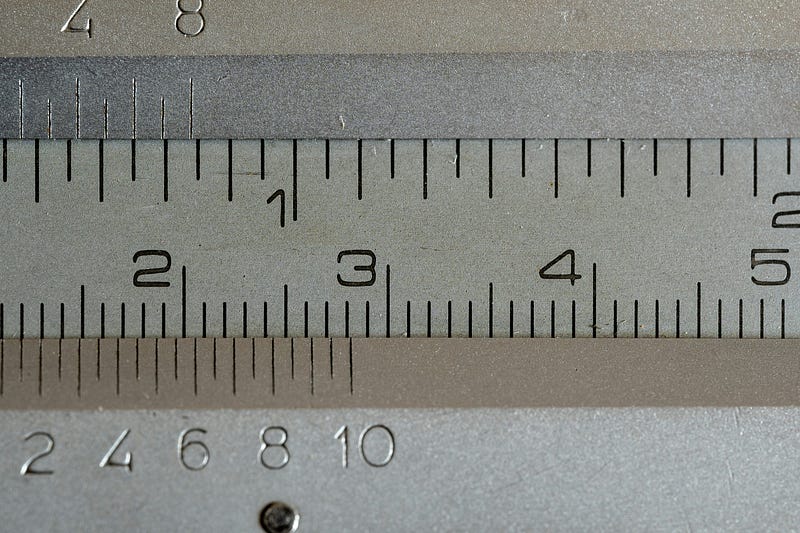
For roughly two centuries the two systems coexisted on fairly even terms: imperial spreading with British colonial trade, metric spreading with French influence and, later, scientific convention. Then the British Empire itself went into decline, and one by one the countries that had inherited imperial units dropped it for something easier to calculate with. Even the United Kingdom converted in the 1960s. The United States did not. It’s now the odd one out among nations that were once its closest peers on this question.
Two Chances, Two Failures
The US actually had an early opening to avoid all this. Right after independence, the Founding Fathers debated scrapping British units entirely as a symbolic break from the old empire. Thomas Jefferson asked France to send over a physical reference kilogram (a grave) so the new republic could calibrate a metric standard. The ship carrying it was seized by pirates in the Caribbean, and the reference object was never delivered. Wikipedia’s account of the Metric Conversion Act traces the question back to George Washington’s very first message to Congress in 1790. It has been unresolved longer than almost anything else in American law.
The country got a second, much more serious shot in the 1970s. On December 23, 1975, President Gerald Ford signed the Metric Conversion Act, declaring metric the United States’ “preferred system” and establishing the U.S. Metric Board to coordinate a national switch. Road signs, school curricula, and industrial standards all began preparing for conversion.
The catch, built into the law itself, was that conversion was “completely voluntary.” No mandate, no deadline, no penalty for not switching. Faced with a choice, most companies and consumers didn’t. The U.S. Metric Board spent seven years failing to generate enough voluntary momentum and was abolished in 1982 under President Reagan. Metrication in the US went from national policy to a punchline.
The objections at the time sound familiar today. Some were cultural: metric was cast by parts of the public as a French (later, more broadly “foreign”) imposition on a country that had just spent a century inventing modern manufacturing under its own units. The joke people told was that there are only two kinds of countries: those that use the metric system, and those that have put a man on the moon. If the world wanted a common standard, the argument went, the world could adopt inches.
The other objection was blunter: cost. Retooling factories isn’t a matter of relabeling numbers. Precision machine tools, dies, and the control software running them had been built to imperial tolerances for generations. American manufacturers in the 1970s estimated the price of a full switch in the hundreds of billions of dollars: money with an obvious near-term cost and a diffuse, delayed benefit. Politically, that’s a losing trade: the pain shows up in this term, the payoff shows up in someone else’s. Congress chose the version of the problem it could postpone, and the US has been postponing it ever since. The longer the postponement runs, the more the country builds on top of imperial units, and the higher the eventual switching cost climbs. It’s a compounding bill nobody in office wants to be the one to pay down.
When the Two Systems Collide
The everyday cost of running two systems in parallel is mostly invisible: a driver squinting at a speedometer, a nurse doing mental math between pounds and kilograms. Occasionally it isn’t invisible at all.
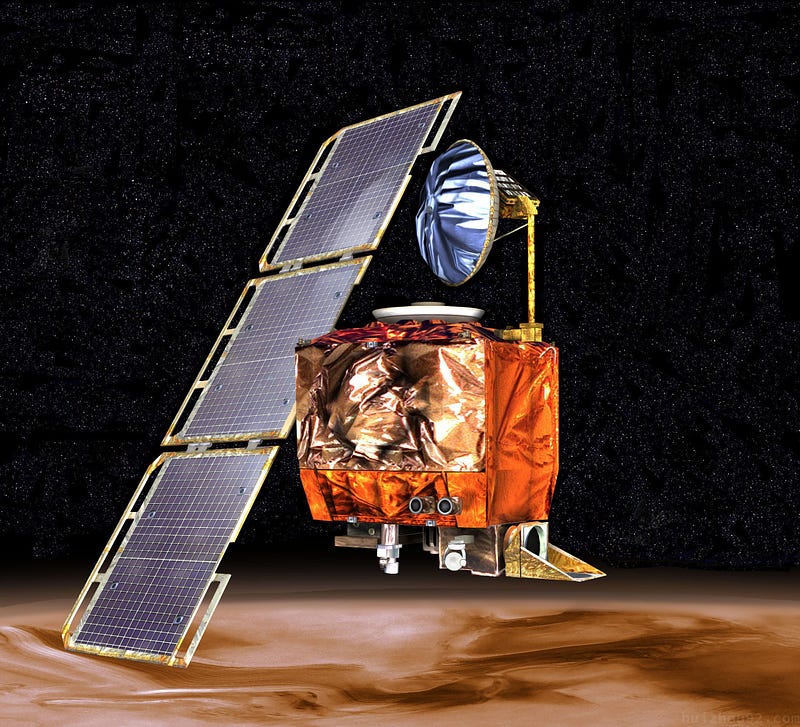
On September 23, 1999, NASA lost the Mars Climate Orbiter. The spacecraft had traveled nearly 10 months and 416 million miles to reach Mars, and it should have settled into orbit at an altitude of about 226 km. Instead, telemetry data later reconstructed by investigators showed it had come in at closer to 57 km, low enough to be torn apart by atmospheric drag.
The cause, once engineers dug into it, was almost absurdly small. Spacecraft manufacturer Lockheed Martin had built ground software that calculated thruster impulse in pound-force seconds, an imperial unit. NASA’s own navigation team at the Jet Propulsion Laboratory assumed, as the mission’s specifications required, that the numbers coming in were in newton-seconds, the metric equivalent. Nobody caught the mismatch. One pound-force-second equals roughly 4.45 newton-seconds, so every correction the navigation software applied was off by a factor of 4.45. That was small enough to go unnoticed for months of cruise and large enough to send the spacecraft catastrophically off course on arrival. The mission (spacecraft, launch, and operations combined) cost $327.6 million. All of it burned up in Mars’ atmosphere over one bad unit assumption.
Sixteen years earlier, a nearly identical mistake almost killed 69 people. On July 23, 1983, Air Canada Flight 143, a brand-new Boeing 767 and one of the airline’s first aircraft using metric fuel measurements, took off from Montreal for Edmonton. The aircraft’s fuel gauge was malfunctioning, so ground crew calculated the fuel load by hand: how many liters were in the tanks, multiplied by fuel density, to get a weight in kilograms.
They used the conversion factor for pounds per liter (1.77) instead of the correct figure for kilograms per liter, roughly 0.8. The plane took off believing it was carrying 22,300 kg of fuel. It was actually carrying about 10,100 kg, less than half of what the flight required. At 41,000 feet over Manitoba, both engines flamed out from fuel starvation.
With no engine power and a mostly-dead cockpit, Captain Robert Pearson and First Officer Maurice Quintal glided the powerless 767 more than 17 miles to a decommissioned Royal Canadian Air Force base at Gimli, Manitoba, a runway Pearson happened to have trained on years earlier as an Air Force pilot. Pearson used a maneuver borrowed from glider flying, a forward slip, to bleed off excess altitude on final approach. The aircraft landed with no fatalities and only minor injuries. It’s remembered today as the Gimli Glider. It happened in Canada, not the US, precisely because Canada was in the middle of its own conversion to metric at the time, with imperial-trained ground crews still doing the math by hand.

Costs like these don’t advertise themselves the way a headline crash does. They show up as slightly wrong purchase orders, re-machined parts, and translation errors between American suppliers and metric customers overseas. Estimates of the aggregate drag on the US economy from running two systems side by side (extra conversion labor, rework, international trade friction) run to roughly $17 billion a year.
The One Metric Unit Americans Never Argue about
There is exactly one corner of American life where metric units won without a fight: firearms. Ammunition is sold and marketed by millimeter (9mm, 5.56mm, 7.62mm), and nobody campaigns to rename it “the .354 caliber.” Even American schoolchildren pick up “nine millimeter” as a functioning unit of measurement well before they’ve had a metric lesson in school.

It’s a small, telling exception: when a metric unit becomes the industry standard for a product category, Americans use it fluently, no different from anyone else. The resistance was never really about metric units being hard. It was about who pays to switch, and when.
That, more than culture or stubbornness, is the actual mechanism behind fifty years of inertia. The benefits of conversion are structural and long-term: cheaper trade, fewer conversion errors, easier manufacturing partnerships. The costs are immediate, concentrated, and easy to blame on whoever’s in office when the bill comes due. Voters and shareholders both react to the second kind of cost a lot faster than they credit the first kind of benefit. Every year the switch doesn’t happen, the country builds a little more infrastructure on top of imperial units, and the eventual bill gets a little larger, which makes the next year’s decision to postpone slightly easier to justify than the last one’s.
Every generation of American engineers has, in effect, left the conversion for the next one. At this rate, there may never be a generation that doesn’t.
For a closer look at how this stalemate actually plays out on American roads, in classrooms, and in Congress, Cheddar’s explainer is worth six minutes:
Sources:
Metric Conversion Act — Wikipedia;
Statement on Signing the Metric Conversion Act of 1975 — The American Presidency Project;
Mars Climate Orbiter cost and cause — Everyday Astronaut;
Gimli Glider — Wikipedia.