The Most Expensive Form of Fake Work
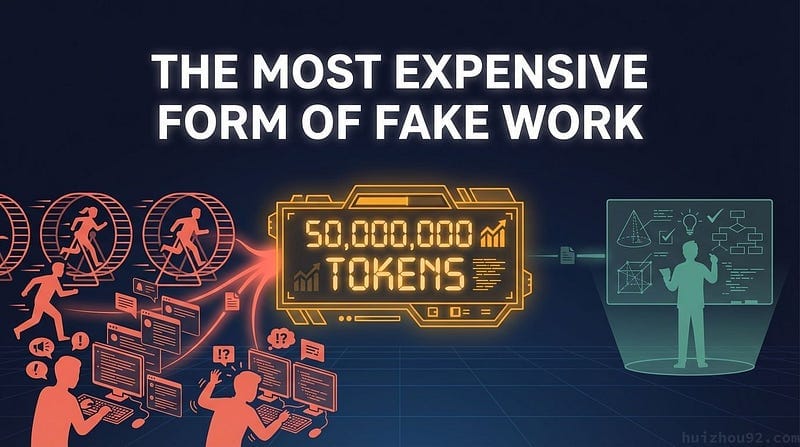
Tokenmaxxing: when AI Consumption Becomes a KPI
An OpenAI engineer burned through 210 billion tokens last week. In seven days. That’s every word on Wikipedia, read front-to-back 33 times. Meanwhile, a Claude Code user at Anthropic racked up $150,000 in compute bills in a single month.
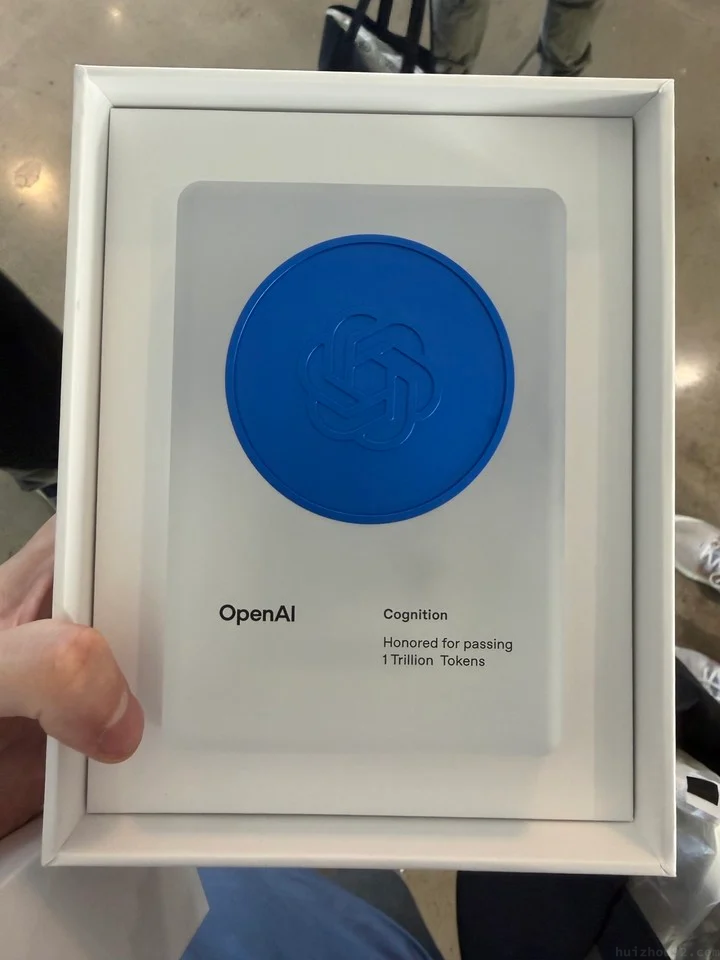
People are sharing these numbers like high scores.
Token Leaderboards Are Real now
Meta, Shopify, and OpenAI have internal dashboards that rank employees by token consumption. Real-time. Publicly visible.
Jensen Huang said the quiet part out loud:
If your $500K engineer isn’t burning at least $250K in tokens, something’s wrong. I’d put them on a warning.
Over in China, Tencent and Alibaba hand out token budgets like gym memberships. A Xiaomi team lead posted on X: “Anyone on the MiMo team with fewer than 100 conversations tomorrow can quit.”
People are calling it Tokenmaxxing. Maximize consumption, not output.
What Does Token Consumption Actually Tell You?
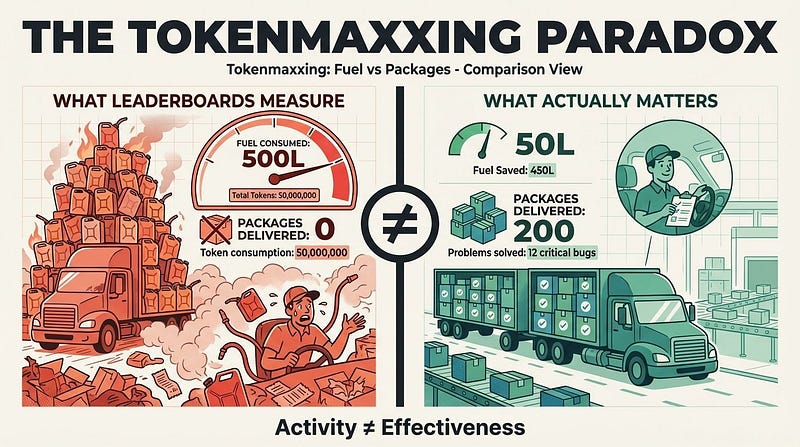
Here’s an analogy I keep coming back to: it’s like rating delivery drivers by fuel burned instead of packages delivered.
A developer who spent three hours going in circles with Claude will rack up way more tokens than one who thought for twenty minutes, wrote the fix in ten, and moved on. The leaderboard says the first person worked harder.
Token consumption could mean you solved something genuinely hard. It could also mean you had an AI rewrite the same email twelve times. On the dashboard, those look identical.
Why Managers Love This
I get why the metric is seductive. Evaluating engineers used to mean code reviews, uptime tracking, and retrospectives on technical decisions. All slow. All subjective. All require you to actually understand what someone built.
Token consumption is none of those things. Open a dashboard, see a number. Done.
You can probably see where this goes. An engineer who burns ten million tokens iterating in the wrong direction looks “harder working” than one who thinks quietly for an afternoon and ships a clean fix. The dashboard can’t tell them apart. Increasingly, neither can the people reading it.
Fake Work Got an Upgrade
We used to perform busyness with browser tabs. Now we do it with Agent windows.
Gergely Orosz:
Inside big tech companies, not being able to use AI at extreme speed is becoming a career risk, regardless of the quality of your output.
Career risk. Not efficiency risk. There’s a gap between those two phrases you could drive a truck through. When burning tokens becomes self-preservation, people will burn tokens, whether or not anything useful comes out the other end.
The Ratchet
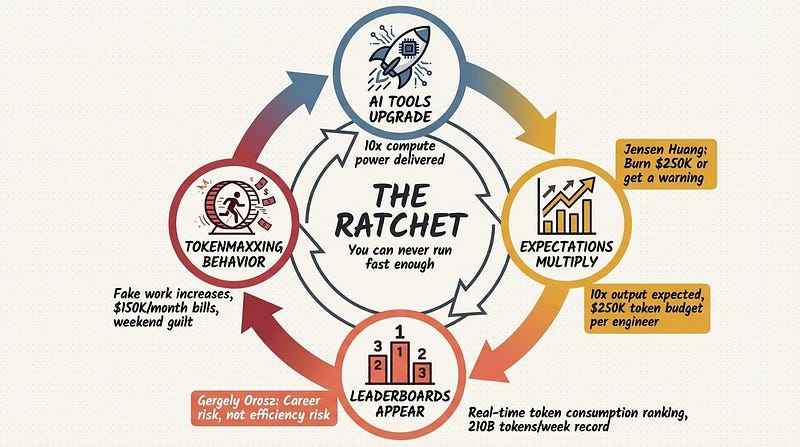
Give an engineer ten times the compute, and management doesn’t expect 10% more output. They expect ten times more.
That math never works in the employee’s favor. Higher tool costs demand higher returns, not more comfortable afternoons. “AI-powered efficiency” sounds like doing the same work with less stress. What it actually means, in practice, is doing dramatically more, starting immediately, no breathing room.
The token leaderboard is that expectation, made visible.
Token Anxiety
VC Nikunj Kothari wrote about something he calls “Token Anxiety,” and I think he put his finger on something real.
People in tech feel guilty when their agents aren’t running. Weekends feel wasteful. Watching a movie feels like leaving compute on the table. The new Silicon Valley small talk isn’t “what are you working on” but “how many agents are you running right now?”
I don’t have a clean label for that. Compulsion, maybe. It’s definitely not productivity.
The whole point of tools is to free up time for what matters. If the tool makes you feel worse when you stop using it, something went sideways.
What Actually Matters
I use AI constantly. It genuinely helps. This isn’t a “throw out the tools” argument.
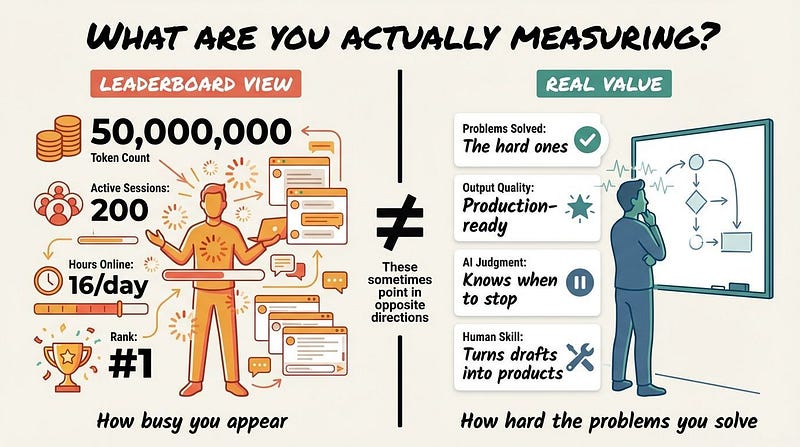
But we’re measuring the wrong thing. The engineers I admire know which problems to throw at the AI and which ones to sit with. They get quality output without endless iteration. They catch when the model is confidently wrong. They turn rough drafts into things that actually ship.
A token leaderboard can’t see any of that. It sees volume. And volume and value sometimes correlate, but they can also move in opposite directions.
So what is Tokenmaxxing, Really?
A way for organizations to feel productive without the harder work of judging actual results. Real-time numbers instead of real judgment. Quantity instead of quality. The appearance of objectivity so nobody has to make a difficult call about who’s actually good at their job.
The scary part isn’t people slacking. It’s people who genuinely believe they’re working hard, while their ability to think without the crutch quietly erodes behind that belief.
Your agents running around the clock doesn’t mean you’re thinking. I keep wondering how many of those 210 billion tokens produced last week were actually read by a human.