The Man Who Lost a Copyright Battle — and Gave the World ZIP
Phil Katz copied his way into court, rebuilt his compression format from scratch, and left his initials inside billions of files
IT HISTORY
The Man Who Lost A Copyright Battle — And Gave The World ZIP
A lot of the files on your machine are zip archives wearing a different extension. Rename a .docx to .zip, open it with any unzip tool, and you get a folder full of XML. Same for .xlsx and .pptx. Android's .apk is a zip. So is the .epub on your e-reader.
A format finalized in 1989 is carrying most of the world’s packaged data. It’s free, it compresses well, and it’s fast.
All of which starts with Phil Katz, who spent his career writing compression software.
The Copier
In the mid-1980s, moving a file on a PC meant a BBS — a bulletin board you dialed into over a phone line. Bandwidth was tiny compared to file sizes, and sending one could take minutes or hours. Compression tools were not optional.
The dominant one was ARC, from a company called System Enhancement Associates, SEA for short. The files it produced ended in .arc.
Katz wrote his own program, PKARC. It read and wrote the same ARC format but ran much faster. Word spread through the BBS scene, and before long more people were using it than ARC itself.
SEA took him to court for trademark and copyright infringement.
The court appointed an independent software expert. The finding: PKARC was a derivative work of the ARC program. The comments in the two codebases were identical in many places, down to the same spelling mistakes.
On August 2, 1988, Katz settled. He paid $22,500 in back royalties and $40,000 in costs, and agreed to hand SEA 6.5% of revenue on ARC-compatible products through January 31, 1989. From that date, he could no longer sell anything ARC-compatible or use SEA’s ARC trademark.
After Losing
The ban cut off the company’s main source of income. So he wrote a new compression format from scratch, unrelated to ARC, and called it ZIP.
On February 14, 1989, PKWARE and Infinity Design Concepts put out a joint announcement: the ZIP format was going into the public domain. The statement carried a promise: the format would stay free for competitors to implement. Including the company that had just taken him to court.
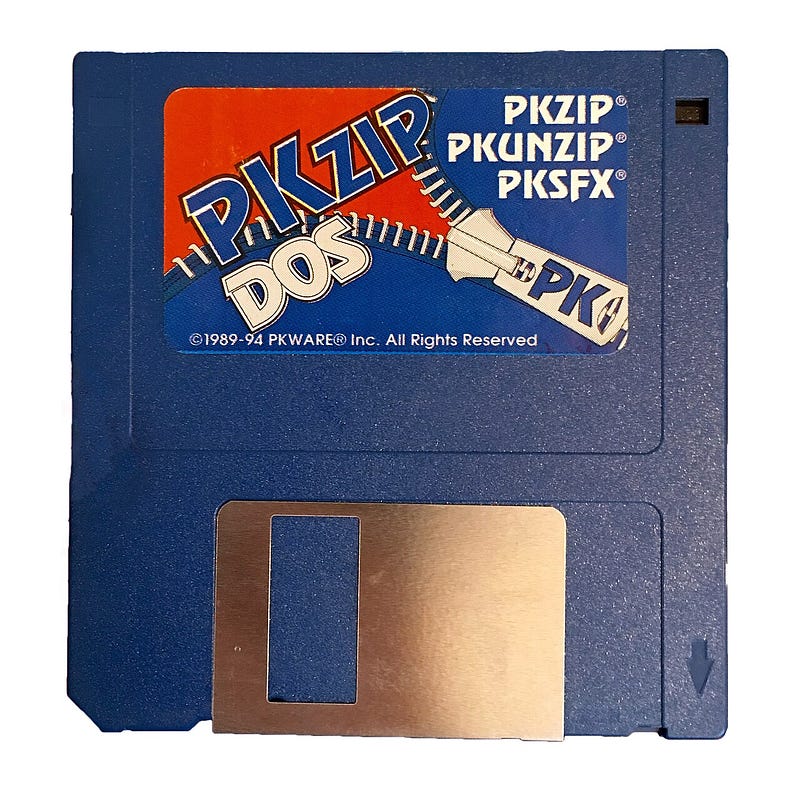
ZIP compressed better than ARC, and the format was open. In the era of floppy disks and dial-up, those two things decided it. ZIP spread fast. Within a few years ARC had faded, and SEA was gone.
Swapping out LZW, Three Years Early
Early ZIP used LZW.
The name comes from three surnames: Lempel, Ziv, Welch. The first two published LZ77 and LZ78 in 1977 and 1978, the root of this whole family of algorithms. In June 1984, Terry Welch published a paper in IEEE Computer reworking LZ78 into something more practical: one pass over the data, dictionary built on the fly, no need to gather statistics first, and not much code.
Machines were slow, and memory was small, and LZW hit every one of those constraints. It became the default: Unix compress used it, GIF used it, TIFF used it, and so did early ZIP.
Welch did that work while employed by Sperry. Sperry filed for a patent in June 1983 and got it in December 1985. In September 1986, Burroughs bought Sperry for $4.8 billion, and the merged company became Unisys. The patent went with it.
Around March 1991, ZIP dropped LZW and switched to DEFLATE, a derivative of LZ77. Katz filed a patent on that one himself, with his own name on it, and ZIP stayed free.
By then the LZW patent had been sitting in Unisys’s portfolio for six years. Nobody had come to collect yet.
Three years later, in 1994, Unisys announced it would start charging royalties on LZW.
This was a catastrophe at the time. GIF ran on LZW, and GIF was the one image format the web had. Every company shipping imaging software woke up potentially infringing. PNG came directly out of that crisis — design started in early 1995, aimed squarely at replacing GIF, and it used DEFLATE. Developers bitten by LZW moved to DEFLATE for their replacements: gzip, for instance, took over from Unix compress. HTTP later used it for compressing traffic.
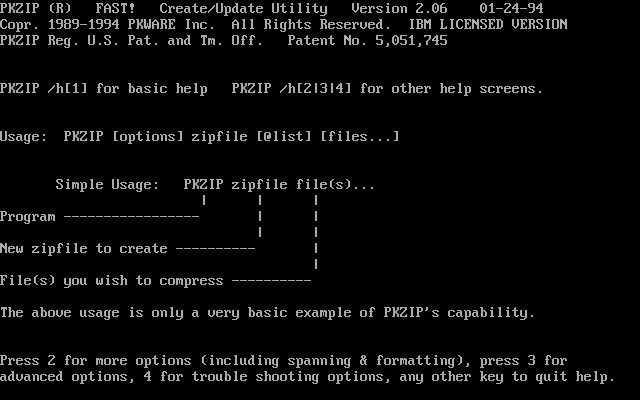
Katz held every right to DEFLATE and never once exercised them. The compression layer of the entire internet sits on an algorithm that is patented and whose patent holder never charged for it.
ZIP surviving this long was not luck. It came out of giving up control twice, both times after the copyright system had gone through him.
Open Format, Paid Tool
Commercially, PKWARE ran a strategy nobody else was running: the ZIP format was open and free, and the money came from selling PKZIP, the software. Decompression was free. You only paid the $25 if you needed to create an archive. By the end of the decade, PKWARE products were in more than 90% of Fortune 100 companies.
Today almost nobody pays to unzip a file. That nag screen WinRAR still shows you is what the other road looks like.
PK
The first four bytes of every .zip file are 50 4B 03 04. The first two, 50 4B, read out in ASCII as PK. Phil Katz.

Run xxd -l 4 on any zip file you have. The right-hand column is his name.
References
- ZIP format specification, APPNOTE.TXT: PKWARE
- SEA vs. PKWARE settlement and timeline: Wikipedia · ARC (file format)
- The Unisys LZW patent and GIF: The Unisys LZW Patent and GIF files
- DEFLATE: Wikipedia · Deflate
- LZW patent: US 4,558,302 (filed 1983–06, granted 1985–12, assigned to Sperry, later Unisys)
- Terry Welch, A Technique for High Performance Data Compression, IEEE Computer, June 1984
- ARC’s retroactive format closure and the BBS backlash: ARC (compression format) · Archive Team
- PKZIP shareware pricing and free PKUNZIP: Wikipedia · PKZIP

Support writers. All our nonprofit’s offerings here.
Click here to subscribe to the IT Chronicles newsletter.
Click for Wordsmith, Mystery Writing, Write Like Stephen King, more