The Feature That Made Java Famous Was Already Dead. JDK 26 Just Filed the Paperwork.
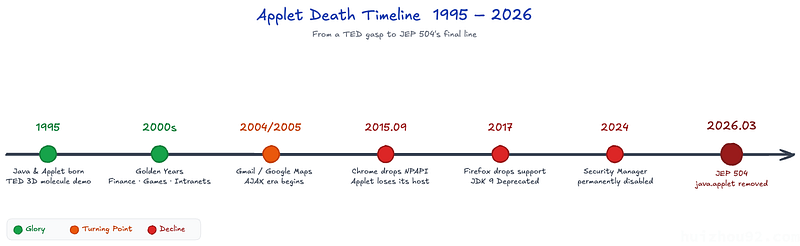
The Feature That Made Java Famous Was Already Dead. JDK 26 Just Filed the Paperwork.. Monterey, 1995 James Gosling moved the mouse. On screen: a browser wi。
Monterey, 1995

James Gosling moved the mouse.
On screen: a browser window. Inside it — a 3D molecule.
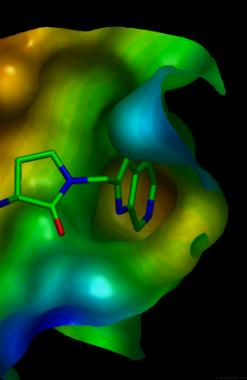
He dragged the cursor. The molecule rotated.
The room went silent. Then the gasps came.
This was 1995. Web pages were walls of text and grainy images.
Nobody thought a browser could do anything interesting.
Gosling had just run a rich, interactive application inside one.
The audience erupted. People turned to each other:
“What language is that?”
Java went from obscure to everywhere — overnight.
What Was Applet?
The technology behind that demo was called Java Applet.
The name holds a small engineering joke: Application + let — a “little application.” The same pattern gave us Servlet (Server + let).
The mechanics were simple:
<applet code="Hello.class" width="460" height="160"></applet>The browser spotted the <applet> tag, invoked the local Java plugin, downloaded the .class file from the server, and ran it in a sandbox.
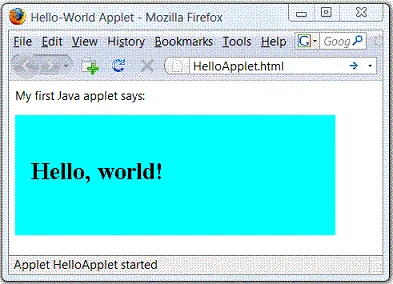
At the time, this felt like magic.
C/S architecture could build rich GUIs — but required installation. B/S architecture required no installation, but only displayed static pages.
Applet was the first technology to combine zero-installation and desktop-level interactivity.
Nobody could resist.
Photo by Unsplash
The Golden Years
Around 2000, Applet was everywhere.
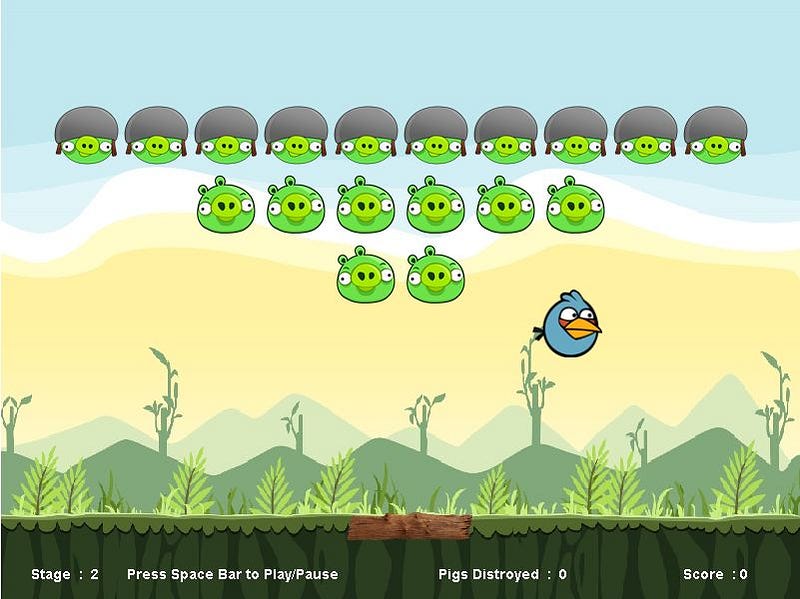
Financial firms used it for real-time stock charts. In those days, dynamic graphs inside a browser were a genuine competitive advantage. Online games ran Java chess and puzzle apps. Enterprise intranets replaced thick desktop clients with Applet-based dashboards.
But cracks appeared early
Speed was the first problem. A 1990s PC with 32MB of RAM was high-end. Java had no JIT before JDK 1.2 — it ran slowly on standalone machines, let alone inside a browser plugin.
Bandwidth was the second. Dial-up meant 56Kbps. A moderately complex Applet could take minutes to download. During the wait: a blank white box.
If the user also needed a specific JRE version? An hour, minimum.
Version hell was the third. Your Applet required JRE 1.4. The user had 1.3. Compatibility error. They had 1.6? Different behavior. Every JRE update was a new gamble.
Any one of these was tolerable.
Together, they were a UX disaster.

2005: AJAX Changed Everything
2005 was the turning point.
Google launched Gmail. Then Google Maps. Both ran on a then-obscure technology: AJAX.
People suddenly realized: pages could update without reloading. Data could load without navigation. Desktop-like interactions were possible — in plain HTML and JavaScript.
AJAX wasn’t as powerful as Applet. It couldn’t do 3D rendering or low-level system calls. Its ceiling was lower.
But it won on another dimension: light, fast, open.
- No plugin
- No JRE
- Standards owned by W3C — not a single company
- Any frontend developer could use it
Applet was one company’s solution. AJAX was the internet’s.
The internet has never tolerated single gatekeepers.
In the years that followed, the frontend ecosystem exploded. jQuery. CSS3. HTML5. One capability after another became a browser standard. Applet’s “exclusive advantages” eroded — and eventually disappeared.
The Long Death
Applet didn’t die in a single moment.
It bled out, slowly, over the years.
September 2015: Chrome permanently removed NPAPI plugin support. Applet depended on NPAPI. The world’s most-used browser had shut the door.
2017: Firefox 52 dropped all NPAPI plugins except Flash. Java was out.
Two browsers gone. The runtime environment had effectively ceased to exist.
Java itself started cleaning house.
JDK 9 (2017): java.applet marked Deprecated. A warning.
JDK 24 (2024): A deeper cut — Security Manager permanently disabled. The Security Manager was the foundation of Applet’s sandbox model. Without it, Applet’s security architecture was gone.
JDK 26 (March 2026): Oracle published JEP 504 and removed:
java.appletjavax.swing.JAppletjava.beans.AppletInitializer
Oracle classified this as a clean-up feature. The language is precise.
This wasn’t a murder. It was a death certificate — issued years after the actual death.
OpenJDK’s official statement put it plainly: modern JDKs and browsers had long stopped supporting applets. JDK 26 simply removed a branch already inoperable.
From 1995 to 2026: 30 years, start to finish.
WebAssembly: The Dream Didn’t Die
Applet is gone. The dream it carried isn’t.
“Run compiled, high-performance code inside a browser.”
That idea re-emerged in 2017 as WebAssembly.
The parallels are hard to miss:
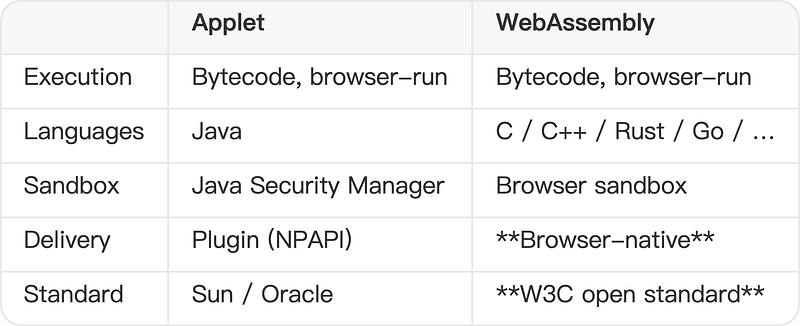
The critical difference: no plugin, no installation, built into every modern browser.
The standard is owned by W3C. Google, Mozilla, Apple, and Microsoft all had a seat at the table. No single company controls it.

The war Applet lost in 2005? WebAssembly fought it again — this time with the right approach.
The Bottom Line
JDK 26 removing Applet isn’t Java’s failure.
It’s proof Java won the right war.
Java lost the browser plugin client. It won servers, cloud-native infrastructure, toolchains, and enterprise runtimes. The Java applications running on countless servers today are where the 1995 dream actually lives.
The Java inside browsers has been dead for years.
The Java that survived is healthier than ever.
Technology works this way: open standards outlast proprietary control.
Applet’s story has no villain — it chose the wrong road, and the internet corrected course.
Summary
- 1995 — Applet made Java famous overnight: the first technology combining zero-install deployment with desktop-grade interactivity
- Three fatal flaws — slow JVM (no JIT before JDK 1.2), dial-up bandwidth, and version hell
- 2005 — AJAX didn’t outpower Applet; it outpowered it. Open standards beat proprietary control
- 2015–2017 — Chrome and Firefox removed NPAPI. The runtime environment vanished
- 2024–2026 — Security Manager disabled (JDK 24);
java.appletremoved (JDK 26 / JEP 504) - WebAssembly — same bytecode dream, W3C open standard: the correct version of what Applet tried to be
References
- JEP 504: Remove the Applet API — OpenJDK
- Oracle Releases Java 26 — Oracle
- NPAPI deprecation: developer guide — Chromium
- NPAPI Plugins in Firefox — Mozilla
- Java applet — Wikipedia
- WebAssembly — W3C