The "Screwdriver Philosophy" — Why Engineers Are Rebelling Against Bloated Software
When a 14MB ripgrep binary scans 400,000 lines in 18ms while a chat client eats 2.4GB of RAM, developers notice. Here is the ledger behind software bloat.


From a 14MB Ripgrep Binary to a 2.4GB Chat Window — the Engineering and Financial Ledger behind Modern Software Bloat
Run ripgrep across a 400,000-line repository in the terminal, and the regular expression match finishes in 18 milliseconds. The task completes, the process exits immediately, and peak physical memory stops around 14 MB.
On the same machine, a desktop team chat client sits in the background after receiving a few dozen lines of text all day. It holds 2.4 GB of resident physical memory and keeps seven Helper subprocesses alive.
Over the past twenty years, single-machine CPU clock speeds and memory capacities multiplied by orders of magnitude. Yet on a workstation with 16 cores and 64 GB of RAM, clicking an input box or waiting for a modal popup to fade out often feels no faster than typing on an old machine twenty years ago.

Modern developer workstations pack 16 cores and 64GB of RAM, yet basic UI interactions often feel no faster than machines from twenty years ago. Photo by Ilya Pavlov via Unsplash (Unsplash License).
Hardware compute has long been abundant. Software grew heavy because its objective changed: commercial products no longer want to be a screwdriver you use and put back in the drawer. They want to enclose your entire workflow inside their platform.
1. What Makes a Tool a Screwdriver
In 1978, Doug McIlroy summarized the design principles of Unix in the Bell System Technical Journal. Peter Salus later distilled them in A Quarter Century of UNIX (1994) into three classic lines:
"Write programs that do one thing and do it well. Write programs to work together. Write programs to handle text streams, because that is a universal interface."
Those three sentences defined a strict standard for software tools: do one job well, stay small, cooperate through text streams, and never overstep.

Douglas McIlroy, former head of the Computing Techniques Research Department at Bell Labs, who formulated the Unix philosophy and invented Unix pipelines. Photo via Wikimedia Commons (CC BY 2.0).
Across software engineering, a small cohort of projects has defended this boundary for decades.
Swedish programmer Daniel Stenberg has maintained curl since 1998. Across twenty-eight years, he has turned down countless proposals to bolt on an HTML parser, a graphical interface, or an embedded scripting engine. It does one job: pure protocol transfer. Precisely because it refuses to do anything extra, it fits inside billions of devices, from car dashboards to the Mars Ingenuity helicopter.
Andrew Gallant (BurntSushi) took the same approach when writing ripgrep in Rust, pouring his effort into finite state automata, memory-mapped searching, and SIMD instruction tuning. The binary runs no background daemon and sends zero telemetry. Once the search finishes, it frees its memory and exits.
D. Richard Hipp designed SQLite with the same restraint—skipping an independent database server daemon entirely so tens of thousands of lines of self-contained C code embed directly into the host application, storing an entire relational database in a single cross-platform file. Command-line jq, multimedia engine ffmpeg, and Igor Pavlov's 7-Zip share the same temperament.

A DEC PDP-11/20 minicomputer at Musée Bolo (EPFL). The Unix toolmaker ethos was forged under tight memory ceilings that punished resident background bloat. Photo by Rama & Musée Bolo, CC BY-SA 2.0 fr, via Wikimedia Commons.
Put these utilities side by side and their engineering traits line up cleanly: clear input and output boundaries, zero resident background daemons, and a refusal to creep beyond their core job.
They work like a screwdriver in a toolbox. You pick it up, drive a screw home, and drop it back into the drawer. It leaves no background process behind, and it never pings you the next morning asking if you want to activate an enterprise collaboration suite.
2. Why Commercial Software Cannot Stay a Screwdriver
From a pure engineering standpoint, almost everyone prefers lighter tools.
Commercial financial ledgers rarely allow that restraint.
An ultra-lightweight, single-purpose utility carries a fatal flaw in venture-backed business models: use it and leave. A user opens the tool for three seconds, finishes the job, and closes the window.
In modern enterprise SaaS valuation models, a company's next funding round depends on metrics that run directly counter to "finish and exit": daily active engagement time, seat expansion, and Net Dollar Retention (NDR).
If a product remains a sharp, single-purpose screwdriver, user switching costs stay near zero. A cheaper or slightly faster alternative can replace it tomorrow. To lift retention and enterprise renewal rates, commercial software inevitably expands its functional perimeter:
- A plain code editor grows into an all-in-one suite bundling task boards, team wikis, and instant messaging;
- Open local files get migrated into proprietary cloud formats tied to role-based permission trees;
- Individual local actions get rewired into multi-seat approval chains.
Once a piece of software captures enough of a company's daily coordination loops, migration becomes prohibitively expensive. To check every compliance and administration box on enterprise procurement sheets, secondary features pile up quarter after quarter, pushing bundle sizes and memory footprints upward.
As long as valuations stay tied to engagement time and seat expansion, product roadmaps will only do addition.
3. Abstraction Layers and Externalized Hardware Costs
When features must ship on aggressive quarterly schedules, development velocity takes priority over runtime efficiency.
Writing native interfaces separately for each operating system (macOS AppKit, Windows WinUI) takes time, and maintaining parallel codebases across teams is expensive. The cheapest engineering shortcut is stacking a high-level abstraction layer like Electron: write one web-based frontend and package it across every desktop platform.
From an engineering management ledger, the trade looks compelling. A web team can ship new features across all desktop targets at once and cut delivery timelines in half.
The saved engineering cost never disappears; vendors externalize it onto the end user's local hardware.
Under a native architecture, drawing a text input box calls an operating system window primitive directly. Inside a Chromium-based framework, that same input box requires spinning up an independent browser kernel process, loading hundreds of megabytes of the V8 virtual machine, parsing a DOM tree and CSS rules, and walking a compositor layer tree before a single pixel reaches the screen.
All to draw an input box.
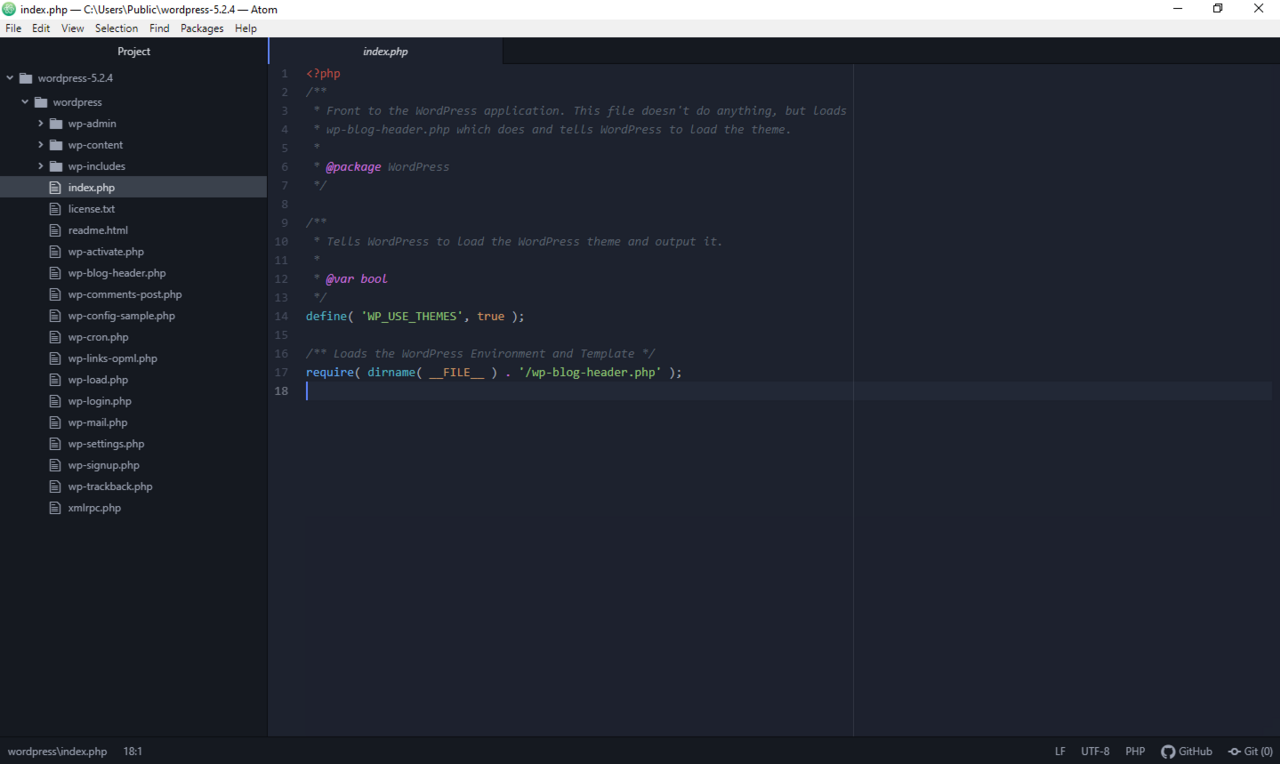
The original Atom text editor interface (v1.41.0), whose Chromium and Node.js shell was extracted to become Electron. Screenshot via Wikimedia Commons (MIT License).
As I broke down earlier in The Promise That Killed Atom Is Now Trapping VS Code, the same mechanism played out in code editors: to fulfill its promise of a "hackable editor," Atom extracted its runtime into Electron, and Microsoft built a 100,000-extension VS Code empire on top of it.
The ecosystem succeeded, at the cost of surrendering the main thread and process tree to layers of third-party plugins. A text editor meant to act like a scalpel gradually swelled into a miniature operating system packed with helper processes and nested Webviews. Much of the core count and memory bandwidth added by modern processors goes toward paying the runtime friction of these abstraction layers.
4. The Return of Lightweight Tools
When the weight of a tool starts getting in the way of the work itself, practicing engineers vote with their feet.
Over the past few years, a clear counter-current has taken hold across technical teams:
- More developers are walking away from all-in-one cloud workspaces, returning to Local-first workflows and plain text (
Markdown + Git) to keep data on local disks; - In data analytics, the rise of DuckDB and SQLite proved workloads once routed through distributed cloud clusters can often finish in a few hundred milliseconds inside an embedded single-node engine on a laptop;
- Across daily development pipelines, compact CLI utilities written in C, Go, or Rust have become the default choice again.
Even in the heaviest category of graphical developer tools—code editors—the pendulum is swinging back.
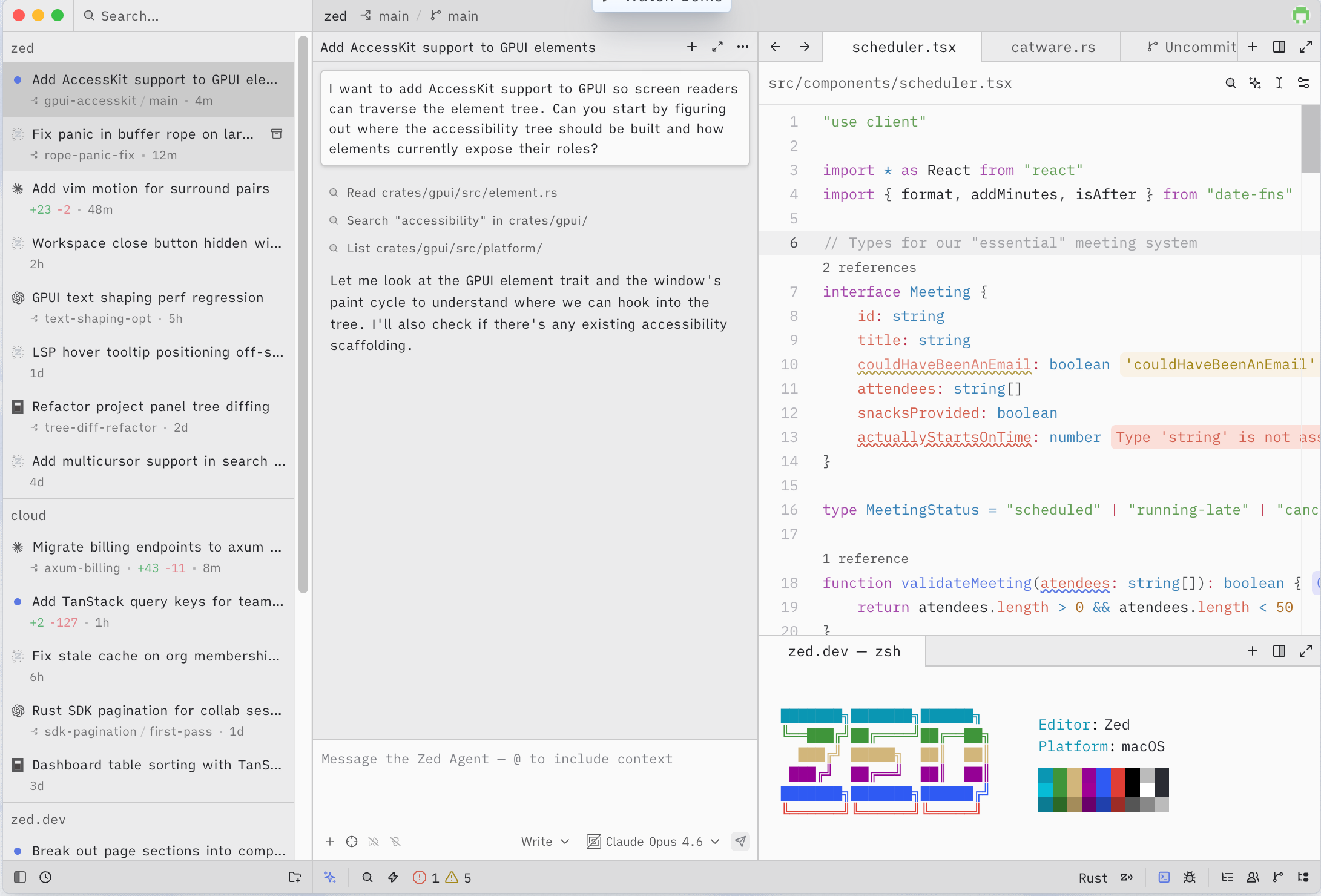
Zed's default workspace, rendered via a custom Rust GPU framework (GPUI) with extensions restricted to WebAssembly sandboxes. Source: Zed Industries.
The clearest example is Zed. Having lived through Electron's performance ceiling as the creator of Atom, Nathan Sobo chose to write a custom GPU rendering engine from scratch in Rust. To protect input latency, Zed made a strict architectural call (documented in the Zed extension docs): extensions are confined to WebAssembly sandboxes, with zero access to UI drawing APIs and no support for embedded Webviews.
That decision permanently gave up any chance of replicating VS Code's 100,000-extension catalog.
In exchange, keystrokes register instantaneously and compute cycles return to the code itself. Most developers who make the switch quickly realize only two or three of those 100,000 extensions are essential to daily work; the rest are interior decoration bolted onto the window.
5. Knowing When to Exit
Platform software has its own commercial ledger to balance, solving enterprise problems around workflow routing, permission governance, and compliance auditing.
For engineers writing code and debugging systems every day, keeping a clear line between a platform and a tool still matters.
Take clear inputs, finish one job cleanly, and hand memory straight back to the operating system—in an era of cheap compute, knowing when to exit has become the rarest quality in software.
References
- McIlroy, M. D., Pinson, E. N., & Tague, B. A. (1978). "UNIX Time-Sharing System: Foreword." Bell System Technical Journal, 57(6), 1899–1904.
- Salus, Peter H. (1994). A Quarter Century of UNIX. Addison-Wesley.
- Stenberg, Daniel. History of curl. curl.se.
- Gallant, Andrew. ripgrep: A fast line-oriented regex search tool. GitHub.
- Hipp, D. Richard. Architecture of SQLite. sqlite.org.
- Zed Industries. Developing Extensions in Zed. zed.dev.


