Silicon Graphics Built the Machines That Made the Movies — Then the Movies Didn’t Need Them
Silicon Graphics Built the Machines That Made the Movies — Then the Movies Didn’t Need Them. IT HISTORY Silicon Graphics Built the Machines That Made the M。

IT HISTORY
Silicon Graphics Built the Machines That Made the Movies — Then the Movies Didn’t Need Them
A reader left a comment under a piece I wrote about Sun Microsystems, another Silicon Valley hardware company that built something close to perfect and still lost. The comment said I’d missed something.
They were right. That piece was about a company that lost the server room. It wasn’t about the one that lost something stranger: an entire category of computing it invented, priced, and perfected, until the rest of the industry decided it didn’t need a specialist for it anymore.
That company was Silicon Graphics. The detail the reader remembered, engineers talking about performance in polygons per second, back when that phrase meant something, is where this one starts.

Walking out of Stanford, 1982
In 1979, an associate professor of electrical engineering named James Clark assembled a handful of graduate students at Stanford to chase a narrow problem. How do you get a computer to draw a moving three-dimensional shape fast enough for a human eye to trust it?
The answer they built was called the Geometry Engine, developed with student Marc Hannah under an ARPA contract. It was a chip, not a program: the geometric math that turns a 3D model into pixels, burned into silicon instead of left to software. Roughly six million operations a second. For 1979, that was fast enough to matter.
Clark didn’t stay at Stanford to publish papers about it. In 1982, he and a group of graduate students and research staff, including Kurt Akeley and Marc Hannah, walked out and founded Silicon Graphics. The first product, the IRIS 1000, shipped the following year. It wasn’t a computer you’d recognize. It was a graphics terminal, meant to plug into someone else’s machine and do the one thing that machine couldn’t do fast enough on its own.
That’s worth sitting with for a second. SGI didn’t start by building better computers. It started by building the one part of computing everyone else treated as an afterthought, and refused to keep treating it that way.
The terminal didn’t stay a terminal for long. By 1985, the IRIS 2000 series had grown into a standalone UNIX workstation, running System V instead of leaning on somebody else’s mainframe. Within a year, SGI switched its processors over to MIPS, the architecture it would build its identity around for the next decade. Each generation did the same thing the first one did: take a workload nobody else could handle in real time, and make it ordinary enough to sit on an engineer’s desk.
Every dinosaur ran on this
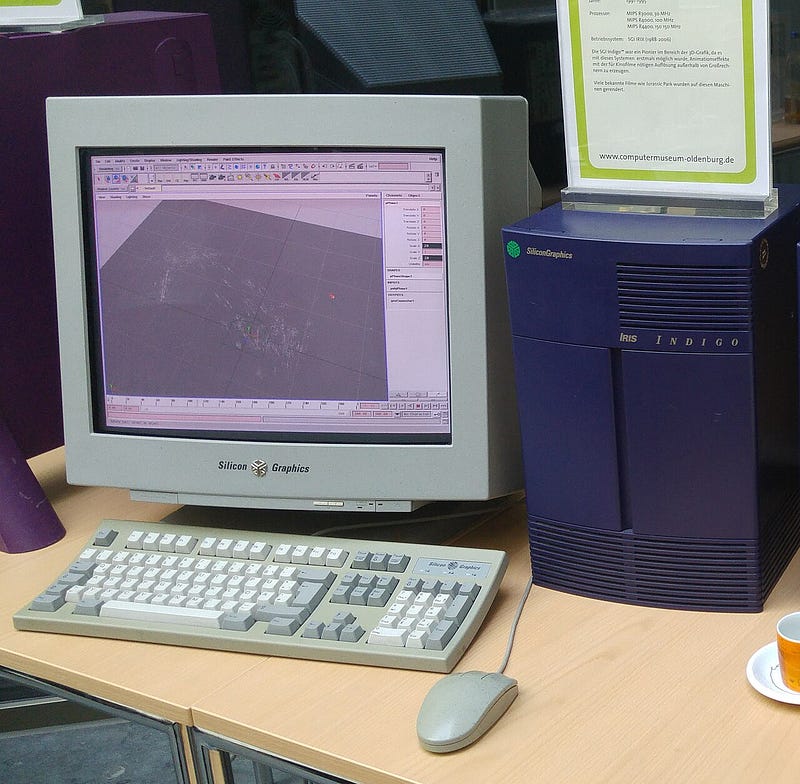
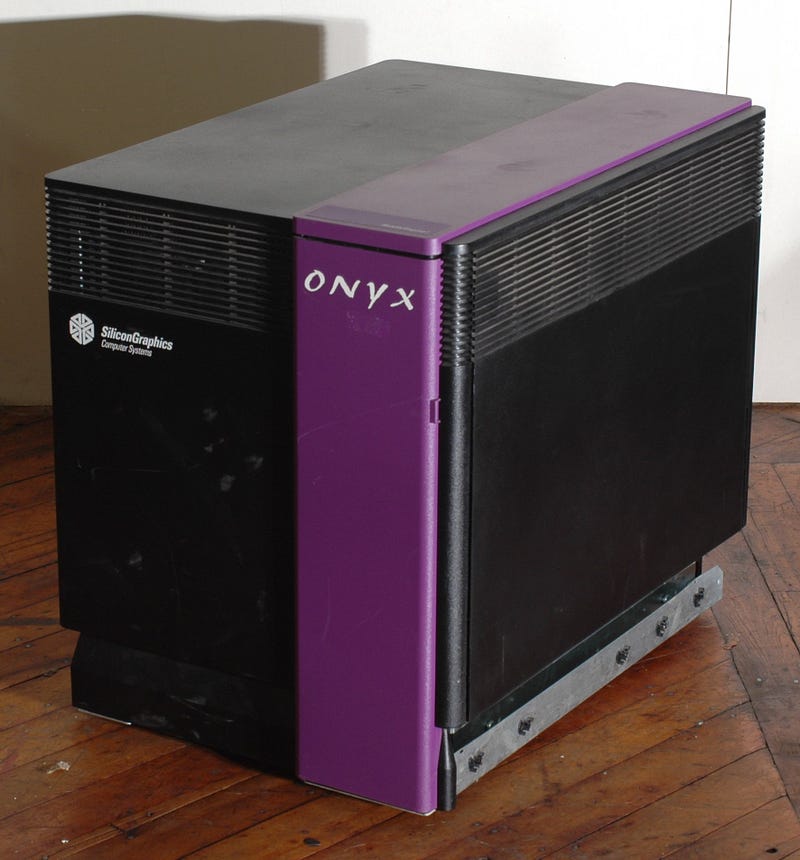
By 1991, Clark’s company had become the default choice for a market it had essentially invented: computer-generated visual effects. Industrial Light & Magic put more than 70 Silicon Graphics workstations to work on Jurassic Park, desktop Indigo machines up through the refrigerator-sized Onyx, SGI’s rack-mounted visualization system built for exactly this kind of load.
One of those machines makes it onto the screen. Samuel L. Jackson’s character runs the park’s control systems from an SGI workstation. The scene most people actually remember, a kid confidently declaring “It’s a UNIX system, I know this” while browsing a 3D file system, happens on a real SGI machine running IRIX, SGI’s own version of Unix. That wasn’t a prop. It was the company’s actual product, on screen, doing its actual job.
The habit stuck. For eight consecutive years, from 1995 through 2002, every single film nominated for the Academy Award for Visual Effects was made on Silicon Graphics systems. Not most years. Every single year, for close to a decade. If your studio wanted to compete for that award, you rented or bought SGI hardware. There wasn’t a credible second option on the table.
Think of SGI, for a moment, as a hospital with one specialty. It didn’t do general medicine. It did one procedure, real-time 3D rendering, better than anyone else on earth, and it charged accordingly. Hollywood studios paid because there was nowhere else to go for that particular operation.
There was also a status dimension to this that’s easy to miss now. An entry-level Indigo cost five figures. A fully loaded Onyx cost more than most people’s houses. Owning one wasn’t just a purchasing decision. It was a way of telling the rest of the industry you were serious. Studios, universities, and defense contractors bought them the way certain firms buy a corner office, partly for what the machine did, partly for what having one said about you.
Seven billion, give or take
Ed McCracken ran Silicon Graphics as CEO from 1984 to 1997. Under him, annual revenue went from $5.4 million to $3.7 billion. The stock followed. SGI’s market capitalization peaked at more than $7 billion in 1995, a number that made it one of the more closely watched companies in the Valley.
The peak looked earned. SGI wasn’t coasting on a lucky bet. It kept extending the technology. The MIPS-based Onyx line handled up to 64 processors while driving multiple simultaneous streams of full 3D graphics. In 1994, CBS News used an Onyx to build real-time 3D election graphics for a national broadcast, replacing a room full of older equipment.
The company backed the bet with its wallet. Worried about securing its own chip supply, SGI bought MIPS Computer Systems outright in 1992 for $333 million and folded it into a subsidiary. That same instinct- own the whole stack, not just the parts you’re good at- showed up again in 1993, when SGI signed a deal to design the Reality Coprocessor, the graphics chip at the heart of Nintendo’s next console. The Nintendo 64 shipped in 1996 with SGI silicon inside it, on a console that would eventually sell more than 30 million units.
SGI wasn’t just building products in this window. It was trying to set the terms other companies built on. In the early 1990s, it co-founded the Advanced Computing Environment initiative alongside Compaq, Digital Equipment, Microsoft, and a dozen other companies, an attempt to standardize a MIPS-based platform that could run both Windows NT and Unix. ACE fell apart within about a year- good intentions, incompatible agendas- but the instinct behind it was the same one that had built the Geometry Engine. Don’t just win the market. Try to define it.
None of this was luck, and none of it was mismanagement. SGI’s engineers kept winning the actual technical competition. The company had, by any reasonable measure available in 1995, gotten it right.
Diagnosis: you can’t patent a category
Here’s where the medical metaphor earns its keep. A specialty hospital’s biggest risk was never a rival hospital doing the same procedure better. Its biggest risk is the procedure itself becoming something a general practitioner can do in an afternoon.
That’s roughly what happened to SGI’s core market, and it happened on two fronts at once. On the server side, clusters of ordinary Linux and BSD machines could take on workloads that used to require a dedicated SGI system: cheaper, less elegant, good enough. On the graphics side, PCs started shipping with real 3D acceleration hardware, and Autodesk ported Maya, the industry-standard 3D software SGI’s own workstations had helped make dominant, over to Windows and Linux. The software SGI had spent a decade making indispensable no longer required SGI’s hardware to run.
And SGI had a hand in its own diagnosis. In 1992, the company took its internal graphics API, IRIS GL, cleaned it up, and released it to the industry as OpenGL, cheaply licensed to competitors, governed by an open consortium instead of kept as a proprietary moat. It was, by most accounts, the right call for the industry. OpenGL became the one 3D graphics standard that worked across platforms for the next twenty years. It was also, in hindsight, SGI handing the rest of the world the blueprint for the thing it used to be the only company that could build.
Management didn’t help. McCracken was pushed out. His replacement, Richard Belluzzo, steered SGI into building Windows NT workstations that put it in direct price competition with Dell, a fight SGI’s premium hardware was never built to win. The company then announced it would abandon its own MIPS processor line for Intel’s Itanium, years before Itanium was ready for anyone, and separately tried its hand at cheap Intel IA-32 servers and workstations. Neither line survived contact with the market. Both moves told customers SGI wasn’t sure what it was anymore, which is close to fatal for a company whose entire pitch had been, "We are the only ones who know how to do this."
The clearest evidence that SGI kept its edge even while its business model failed came from its own employees. In 1997, twenty engineers, led by Wei Yen, who had run the Nintendo 64 chip project, left SGI to found a graphics startup called ArtX. Three years later, ATI Technologies bought ArtX to get its hands on that team’s expertise. ATI, along with Nvidia, was one of the two companies whose consumer GPUs would go on to do to SGI’s market exactly what SGI’s own engineers had just proven they knew how to build.
Compare the two collapses side by side, and the shape becomes clear. Sun lost its server room to Linux and cheap x86 hardware, a business model that never took commodity computing seriously enough. SGI lost its graphics monopoly to the consumer GPU, a technical achievement so complete that the rest of the industry eventually built it into every machine on earth. Different organs, same disease. Each company got so good at one thing that its own success became the reason nobody needed to buy it from them specifically anymore.
Jim Clark already left
Clark wasn’t around to watch the diagnosis play out. He left Silicon Graphics on January 27, 1994, years before the market cap peak, years before Belluzzo’s missteps, years before any of it looked inevitable.
A month later, he reached out to Marc Andreessen, then 22 years old and fresh off building Mosaic, the browser that had made the early web usable for people who weren’t researchers. Clark backed a new company, first called Mosaic Communications, later renamed Netscape after a legal dispute over the name. Netscape’s IPO in August 1995 is the event most historians now point to as the starting gun for the internet stock boom.
Clark’s initial stake in Netscape was $4 million. When AOL acquired the company in 1999, he walked away with $1.2 billion. He went on to found or fund a string of other companies, Healtheon, myCFO, a handful of others, with the same pattern each time: find a market before it hardens into a commodity, move fast, get out with the upside intact.
There’s no need to cast this as betrayal or foresight. Clark wasn’t fleeing a sinking ship in 1994; SGI’s stock wouldn’t peak for another year. He simply moved on to a market that hadn’t been commoditized yet, while the company he’d built kept fighting to defend one that was already being taken apart underneath it. He got to keep doing the part he was good at, spotting an underpriced technical opportunity and building a company around it before anyone else noticed. SGI didn’t get that same second act. It only had the one market to defend, and defending it was somebody else’s job now.
Sold for the price of a rounding error
The market cap tells the rest of the story in three numbers. More than $7 billion in 1995. $120 million in November 2005, the month SGI was delisted from the New York Stock Exchange for falling below the minimum share price. Within three months of that delisting, SGI was warning it could run out of cash by the end of 2006.
It didn’t die quietly, and it didn’t die on the first try. SGI filed for Chapter 11 bankruptcy in May 2006, trying to shed $250 million in debt, and actually climbed back out of it that October: new stock ticker, same struggling business underneath. The MIPS-and-IRIX product line that had built the company’s reputation was discontinued that September; the last orders shipped the following spring. The company spent its final years repositioning itself, not very successfully, as a supercomputer vendor instead of a graphics company.
Then, on April 1, 2009, SGI filed for Chapter 11 a second time, and this attempt didn’t come back out. It announced it would sell nearly everything to Rackable Systems for $25 million. By the time the bankruptcy auction closed a month later, competing bidders had pushed the price to $42.5 million, a small mercy, and also a fairly precise measurement of what was left.
Fourteen years. Seven billion dollars to forty-two and a half million. Rackable renamed itself Silicon Graphics International and kept the name alive on hardware that had nothing to do with the machines that rendered Jurassic Park.
Same ground, different logo
In 1993, at the peak of its confidence and roughly a year before Clark walked out the door, Silicon Graphics began building a 500,000-square-foot corporate campus on a 26-acre site in Mountain View, a genuine collaboration with the city’s planning department to blend private office space with public parkland. The design tucked nearly 2,000 parking spaces underground so the site could hold water features, pathways, and Charleston Park, a five-acre public green space threaded along Permanente Creek. It was a strange thing for a hardware company to spend money on. It won a national landscape architecture award in 1999 for doing something most corporate campuses never bother attempting.
Google leased those same buildings starting in 2003, while SGI was still a going concern, still repositioning itself, still trying to figure out what it was. Google bought the site outright in 2006, the same year SGI filed its first bankruptcy, for $319 million. Today it’s called the Googleplex.
Sit with that number next to the other one for a second. Google paid $319 million in 2006 for the real estate SGI happened to be sitting on. Three years later, a bankruptcy court accepted $42.5 million for what remained of the actual company: the patents, the brand, the engineering. The building was worth more than seven times the business.

The reader who left that comment under the Sun piece wasn’t just correcting an omission. They were describing something that happens more than once in this kind of history. A specialist gets so good at one narrow thing that the thing stops needing a specialist, and the ground it stood on gets repurposed by whoever solved the next narrow thing. Same driveway. Same creek out back. Different lobby, different logo, a dinosaur skeleton in the entrance instead of a rendering farm in the back room.
The engineers who talked in polygons per second weren’t wrong about what they’d built. They just didn’t get to keep it.
Support writers. All our nonprofit’s offerings here.
Click here to subscribe to the IT Chronicles newsletter.
Click for Wordsmith, Mystery Writing, Write Like Stephen King, more
By the EIC Susan Brearley with Ideogram