MIT Unveils Comprehensive AI Risk Database: A New Era in AI Governance
MIT Unveils Comprehensive AI Risk Database: A New Era in AI Governance. Researchers at the Massachusetts Institute of Technology (MIT) have recently introd。
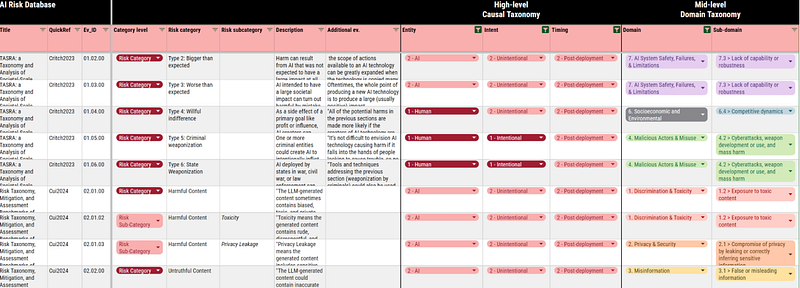
Researchers at the Massachusetts Institute of Technology (MIT) have recently introduced what is being hailed as the most comprehensive dynamic database of AI risks to date, encompassing 777 distinct AI risks across 43 major categories.
This database represents the industry’s first attempt to systematically compile, analyze, and extract AI risks, integrating them into an openly accessible, comprehensive, and scalable classification system. It lays the foundation for standardizing the definition, auditing, and management of AI risks across the industry.
This database serves as an indispensable knowledge repository for AI safety and governance professionals, enabling them to create personalized risk databases for their organizations.
An article from MIT Technology Review highlights the numerous dangers associated with AI technology, including system biases, misinformation dissemination, and even addictive qualities. These risks are just the tip of the iceberg; AI could also be used to create biological or chemical weapons and potentially spiral out of control in the future, leading to catastrophic consequences.
The AI Risk Landscape
To address the urgent need for AI risk governance, MIT’s Computer Science and Artificial Intelligence Laboratory (CSAIL), led by the FutureTech team, developed an “all-encompassing” AI risk database.
According to a news release from the CSAIL website, researchers identified significant gaps in existing AI risk frameworks. The most comprehensive existing frameworks, such as those from NIST, Google, and the European Union, cover only about 70% of all risks. Dr. Peter Slattery, the project leader, expressed concern that decision-makers might overlook critical issues due to cognitive biases, leading to collective decision-making blind spots.
MIT’s AI Risk Database aims to provide scholars, security auditors, policymakers, AI companies, and the public with a “panoramic view” of AI risks, serving as a unified reference framework for researching, developing, and governing AI systems. The database consists of three main components: the AI Risk Database, the AI Risk Causality Taxonomy, and the AI Risk Domain Taxonomy, as detailed below:
AI Risk Database: This database documents over 700 risks extracted from 43 existing frameworks, complete with references and page numbers.
AI Risk Causality Taxonomy: Categorizes AI risks based on their occurrence, timing, and causes.
AI Risk Domain Taxonomy: This taxonomy divides risks into seven domains and 23 sub-domains, covering discrimination and harmful content, privacy and security, misinformation, malicious actors and misuse, human-AI interaction, socio-economic and environmental harms, and AI system security and failure.
A Powerful Tool for AI Governance
Brian Jackson, Chief Research Director at Info-Tech Research Group, believes the AI Risk Database is immensely valuable to corporate leaders responsible for AI governance. It helps organizations identify new AI risks and is a foundational tool for developing specific governance strategies. Furthermore, the database is available as a Google Sheets document, making it easy for organizations to customize according to their needs.
Features and Applications of the AI Risk Database:
General Features:
- Introduces new members to the field of AI risk.
- Provides a foundation for complex projects.
- Supports the development of more refined or specific classification systems (e.g., systemic risks or EU-specific misinformation risks).
- Enables prioritization (e.g., expert scoring), comprehensive analysis (e.g., audits), or comparative studies (e.g., cross-domain public concerns).
- Identifies overlooked areas (e.g., AI welfare and rights).
Applicable Users and Scenarios:
- Policymakers: For developing regulations and shared standards.
- Auditors: For developing auditing standards for AI systems.
- Academia: This identifies research gaps and develops education and training.
- Industry: For internal AI risk assessment, strategy development, education, and training.
Despite some limitations, such as reliance on the existing 43 classification systems that may overlook emerging specific risks, MIT researchers assert that this work lays the groundwork for future AI risk assessments and promotes a more coordinated and comprehensive approach to risk management.
Looking Forward: A New Chapter in AI Governance
As AI technology rapidly evolves and the potential risks accumulate, more companies and institutions exercise caution in deploying AI applications, eager to improve their lagging AI risk governance capabilities.
MIT’s AI Risk Database provides a comprehensive risk map for the healthy development of AI, signaling the beginning of a new chapter in AI governance.
Bart Willemsen, Vice President and Analyst at Gartner, notes that this research marks an essential step toward a deeper understanding of AI technology risks. He looks forward to future versions that list AI risks and offer mitigation measures, providing industry best practice guidelines.