Jeff Dean Just Left Google. The Market Priced Five People at $200 Billion.
Jeff Dean Just Left Google. The Market Priced Five People at $200 Billion.. AI Jeff Dean Just Left — Google’s market value fell by 200 billion US dollars。

AI
Jeff Dean Just Left — Google’s market value fell by 200 billion US dollars.
Jeff Dean, one of Google’s most important AI people, left to start his own company and took five colleagues with him who feel the same way he does. That same day, Google’s stock dropped more than 5%. Something like $200 billion, gone. That’s the market putting a price tag on those five people.
If you work in software, you already know this name. MapReduce. Bigtable. TensorFlow. It’s not much of an exaggeration to say he had a hand in defining the infrastructure the internet runs on. There’s a whole genre of jokes about him online:
- “Jeff’s keyboard only has 0 and 1”;
- “he writes in binary; source code is just his commentary”;
- “his code optimizes itself before it even runs.”
I’m not here to tell his career story. He’d already been at Google for 27 years, most recently leading Gemini. The question is what it means that he’s choosing to leave right now. What does the timing say about where AI is headed?
A few days ago, in a Y Combinator interview, the host asked Jeff Dean: if 25-year-old Jeff time-traveled to today, what would he do? Would he even join a company?
He thought about it for a second, then gave a long, roundabout answer. But it came down to two things:
- Do the thing that has the most positive impact.
- Do it with two or three people you actually like working with.
Here’s the original video, worth watching if you’re curious:
His actions just proved it. He left Google to build something of his own, doing what he thinks matters most, and brought a few of his old friends from Google along. Two or three people he actually likes working with.
So why didn’t he leave ten years ago? Five years ago? Why now?
Start with the facts. Jeff Dean co-founded Google Brain, wrote the first TensorFlow code, and is basically a totem for Google’s AI research. If he’d said ten years ago that he wanted out, Google would have buried him in gold to keep him.
And ten years ago, he really wouldn’t have left. Leaving Google back then would have made it almost impossible to keep doing the work he wanted to do.
In 2016, the stuff you needed to train a decent model was out of reach for almost everyone. Thousands of top-tier GPUs. Terabytes of clean data. A world-class distributed systems team. You could count the companies that had all three on one hand. Startups weren’t even in the conversation.
AI research back then was, as a simple matter of physics, something only big companies could do, because compute and data were scarce and locked up. Startups were where the real innovation happened, sure, but in Jeff’s position, Google was clearly the only place with the resources to actually do the work.
In 2016, staying at Google was Jeff Dean’s best option. He couldn’t leave.

By 2026, everything had changed. Now he could.
Compute got commoditized. Data and models went open. Tooling matured. Everything got easier. When someone as senior as Jeff Dean is willing to walk out and start a company, that alone is the strongest proof you’ll find that AI infrastructure has become a commodity.
Even leaving Google now, whatever compute, data, and organizational muscle he loses, he can just go get on the open market. So what’s there to be scared of?
Don’t mistake his 20-plus years at Google for “loyalty.” It was mostly that Google used to be his best option. Now something better exists, so he took it.
Zoom out further.
In the middle of the last century, research had to live inside a big company. Only giants like Bell Labs and IBM could afford to keep a pure research operation running with no product deadline. For the top scientists of that era, leaving one of those places meant losing the ground they stood on.
Later, the infrastructure matured. A group of engineers at Fairchild Semiconductor took what they’d learned and went and started their own companies. That’s how you got Intel. That’s how you got AMD. That’s the Silicon Valley myth.
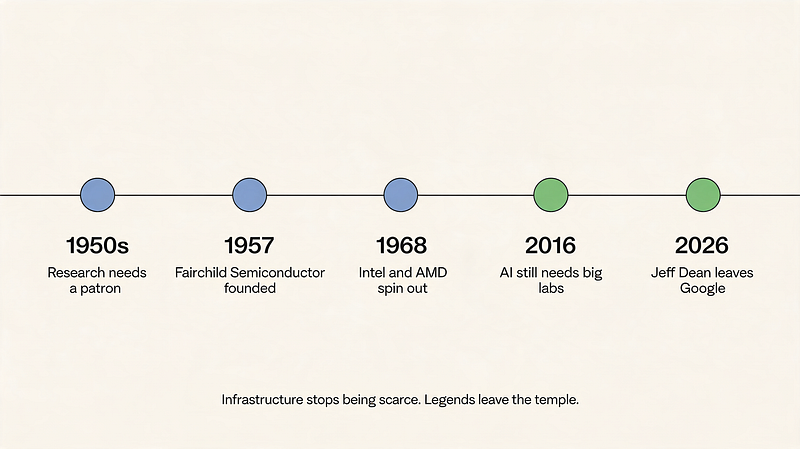
Legends don’t leave the temple because the temple turned bad. They leave because the temple no longer has a monopoly on the magic.
Once infrastructure becomes a commodity, legends leave the temple. That’s an iron law of tech history.
It’s just AI’s turn now.
Jeff Dean isn’t the first big name to leave a major lab to go build AI on his own. He’s just the most senior one, which is why this one actually shook people.
But when someone like Jeff Dean chooses to leave Google and go build on his own, it means the temple era of AI research is starting to close. The center of gravity moves from corporate labs to whoever’s bold enough to build outside them.
Plenty of people will say Jeff Dean left because Google has big-company disease.
That’s not wrong. Every big company has a mountain of problems. But small companies and startups have their own mountain of problems too. Different problems, different headaches.
For any individual, it’s a trade-off; that’s all. Don’t assume a startup is automatically cooler or more likely to do something big.
For Jeff Dean specifically, most of his past success was tied to the organization he was part of, because that organization could supply compute and data nobody else had. His value was bound to Google. Only Google could afford to keep him. And “afford” here doesn’t mean salary and stock. It means the technical and organizational backing behind him.
Now Jeff Dean doesn’t feel tied to any one platform anymore. So he made a different choice.
For any big company still counting on compute, data, or platform lock-in to keep its people, that’s a genuinely dangerous signal.
Once your best people figure out they can get resources without you, your talent moat starts to crack.
Plenty of younger people in Silicon Valley already made this move. Jeff was just slow.
Jeff Dean leaving isn’t one guy quitting his job. It’s a domino falling. AI research is about to be widely understood as something that no longer needs a temple.
As an engineer, watching someone like Jeff Dean walk out of the temple is a little sad, honestly. No party lasts forever. Even the best company eventually has people who leave. There’s no reason to preach loyalty to any one company.
Be loyal to yourself. Listen to what you actually want. Move with the current. That’s what actually matters.