Is Coding About to Have Its “YouTube Moment”?
Is Coding About to Have Its “YouTube Moment”?. Yash Bhardwaj, a 25-year-old product designer, recently floated an idea that’s raised some eyebrows: coding。
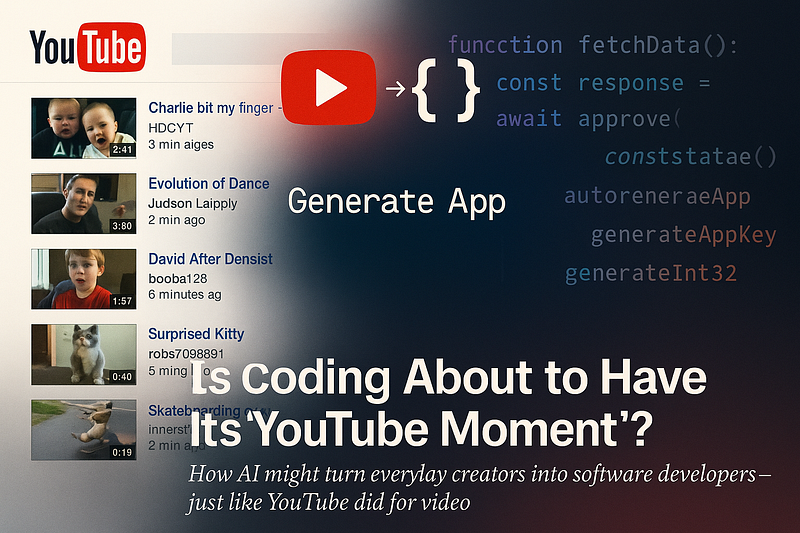
Yash Bhardwaj, a 25-year-old product designer, recently floated an idea that’s raised some eyebrows: coding might be on the cusp of its own “YouTube moment.” The notion was compelling enough to catch the eye of YouTube co-founder Chad Hurley, who shared it with a contemplative 🧐 emoji — equal parts curious and cautious.
Flashback: When YouTube Changed Everything
Bhardwaj points to a trio of breakthroughs that set YouTube on its rocket ride:
- Hosting video online became nearly free
- Editing tools got cheaper and easier to use
- Smartphone cameras dramatically leveled up
While it’s tempting to credit YouTube’s rise to the spread of digital cameras, that’s only part of the story—context matters.
When YouTube launched in 2005, the puzzle pieces weren’t all in place (AWS, for example, wouldn’t officially roll out until 2006). Publishing video online was suddenly easier — but not effortless. The early days were chaotic, marked by brutal competition, burn rates, and copyright headaches. It’s no wonder the founders sold to Google just over a year in.
By 2014, Susan Wojcicki took the helm and turbocharged YouTube’s business engine. She introduced monetization for creators and rolled out ContentID, a system to settle copyright issues, opening the door to licensing deals with record labels and studios. By 2019, the platform was seeing a staggering 500 hours of video uploaded every minute. COVID only poured gasoline on the fire — at one point, YouTube consumed 15% of all internet traffic.
Monetization and licensing changed everything. What started as a playground for hobbyists has evolved into a serious career path built on audience retention and return on investment (ROI).
MrBeast: A One-Man Media Empire

Among the most prominent names to thrive in this new world is MrBeast, also known as Jimmy Donaldson. In 2017, he posted a strange but oddly mesmerizing video of himself counting from 1 to 100,000. It blew up. His subscribers soared from 1 million to 10 million within a year. By 2022, he crossed the 100 million mark — and now he’s way beyond that, with over 400 million followers across platforms.
MrBeast cracked a new code: wild stunts + eye-popping rewards. He even shared a 36-page breakdown of his creative process. It all starts with a killer thumbnail and an irresistible hook. Every cent he spends shows up on the screen.
Consider his 2021 real-life remake of Squid Game. He rounded up 456 contestants to compete for 456,000. The 25-minute spectacle, which cost over $ 3 million and was subtitled in 16 languages, garnered 130 million views in its first week. Today? Over 650 million. That year, MrBeast pulled in $54 million and landed on Forbes’ Celebrity 100 list.
Sure, there’s only one MrBeast — but millions are chasing his blueprint. While “Broadcast Yourself” might not be the rallying cry it once was, YouTube still boasts more than 28 million channels with at least 100 subscribers. Only five have topped 100 million.
Cracking the Code: How Creators Hack the Algorithm
Investor Blake Robbins has studied how top creators decode YouTube’s algorithm:
“Everyone thinks YouTube favors total watch time. So, creators optimize for that. MrBeast is laser-focused on keeping you glued to the end.”
It’s a constant game between platform and creator — sometimes contentious, always creative. And it’s what makes YouTube feel so alive.
What sets YouTube apart from Netflix or NBC? It doesn’t just stream content. It turns everyday people into stars. The platform’s “moment” is comprised of millions of individual moments, such as MrBeast’s.
AIGC Still Searching for Its Spotlight
Despite all the buzz, the tech world hasn’t seen a fresh, breakout platform in years.
After ChatGPT’s splashy debut, many assumed AI would trigger the next great platform wave. Two years in, it’s certainly powerful — 200 million weekly users — but still more tool than revolution.
Why? AI-generated content (AIGC) slashes creative costs but hasn’t yet cracked the code on format. It’s stuck mimicking rather than inventing. Google, ever alert, has stayed nimble to blunt the threat. Meanwhile, human creators are dreaming up things that Hollywood never could.
One reason large-scale adoption has stalled is inference costs. A deep dive into a Chinese report noted that AI tools offer far less value per use for the average consumer compared to business users. The economics don’t pan out — for now.
Then there’s the baggage: hallucinations, ethical pitfalls, mechanical-sounding prose. Platforms tread carefully, layering in guardrails. And viewers still crave a human spark — especially with premium content. Can AI deliver that? Jury’s still out.
For now, AIGC appears poised to blend into existing ecosystems, supporting rather than supplanting user- or professionally created content.
The Magic of Cursor + Claude

Among the most exciting AI products out today? Cursor paired with Claude.
It’s not the first code-gen tool — but it’s arguably the first to go viral for being, well, magical. One clip showed an 8-year-old building a Harry Potter-themed app with Cursor, lightning bolt and all. It drew 2.6 million views on Twitter.
Others have live-streamed solo builds using Cursor — weather apps, full-stack platforms, you name it — often in just a few hours.
In August 2024, Cursor secured $60 million in funding and reported having over 40,000 paying customers. Their mission?
“We want to create a magical tool that helps write the world’s software.”
That’s a bold vision — but one that suddenly feels within reach.
AI coding tools are rapidly improving, with autocomplete features alone reportedly boosting productivity by 20–30%. Greylock has even mapped out the emerging AI dev stack — from writing and reviewing to maintaining code.
But the real prize? Making code creation mainstream.
Look through Bhardwaj’s “YouTube moment” lens, and it becomes clear: the goal isn’t just to help devs work faster. It’s to let anyone build software. Just like YouTube made everyone a creator, AI should turn ideas into apps.
From Niche Skill to Daily Habit
In pre-YouTube America, fewer than 500,000 people were employed in the film and TV industry. Today? Hundreds of millions dabble in video creation.
As of 2024, approximately 30 million people worldwide are software developers.
AI could break down the psychological barriers that prevent most people from even trying to code. The result? A massive, messy explosion of new creators.
Still, roadblocks remain:
- Most tools still cater to pros, with complex interfaces
- Devices like AR glasses could create demand for custom apps — but the ecosystem is not ready
- AI’s utility is tied to inference, not time spent — meaning new reward models are needed
Unlike video, the software lacks emotional pull. No fans, no influencers. Updates are tedious. Code doesn’t usually feel personal.
But the economics are shifting fast:
- Iteration is cheaper
- AI updates extend product lifespans
- Pricing can align with the value delivered
- Interactive formats — especially games — are poised to take off
The Road Ahead: Bold, Maybe Reckless, Predictions
- AI code may give birth to platforms, something AIGC hasn’t yet managed
- “Software generation” will go beyond coding, automating everything from deployment to maintenance
- New platforms will need new discovery models, likely token- or signal-based
- Monetization will evolve, rewarding based on usage impact rather than subscriptions
- “Luxury apps” will rise, bespoke, aesthetic tools like Notion or Perplexity gaining cult followings
- Governance will matter more than ever as scale introduces risk
Back in 2018, Ben Thompson framed a choice in tech:
- Satya Nadella: “We build tech so others can build more tech.”
- Sundar Pichai: “We help you get things done.”
The question is whether tech should spark new possibilities — or make the old ones faster.
Every time a new platform reaches critical mass, it redefines who gets to create. Just as YouTube transformed content creation, AI could do the same for software.
This time, the platform moment belongs to the code.