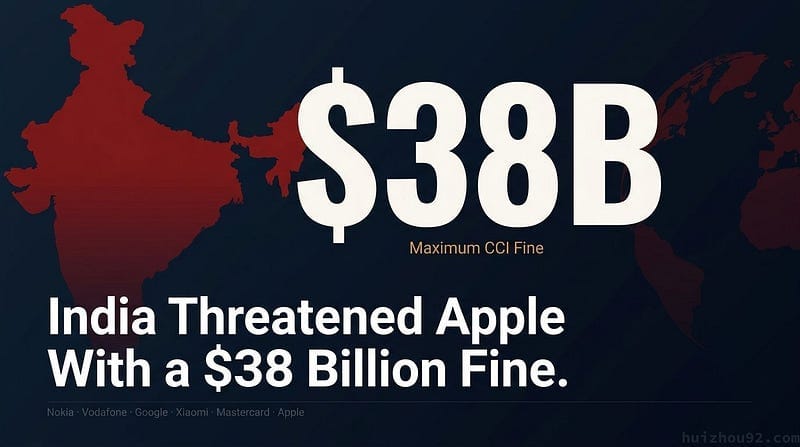
India Threatened Apple With a $38 Billion Fine. Here’s How the Math Works.
India Threatened Apple With a $38 Billion Fine. Here’s How the Math Works.. INDIA AND APPLE India Threatened Apple With a $38 Billion Fine. Here's How the。
INDIA AND APPLE
India Threatened Apple With a $38 Billion Fine. Here's How the Math Works.
The headline landed like a grenade: Apple could face a $38 billion fine in India.
Most people's first reaction: Apple? The most valuable company on earth? India?
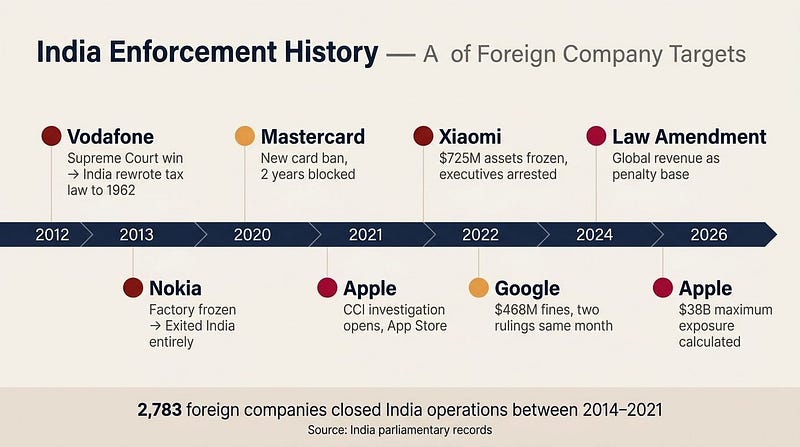
But if you've watched India's track record over the past decade, you stop asking whether India dares. Xiaomi had $725 million in assets frozen and executives arrested. Google paid $468 million in antitrust fines. Vodafone won at India's Supreme Court, and India rewrote the tax law retroactively — all the way back to 1962. Nokia had a factory seized and left the country.
The Apple story is the newest name on a list that goes back years.
The math behind $38 billion
In September 2021, a non-profit called Together We Fight Society (TWFS) filed a complaint with India's Competition Commission (CCI) against Apple's App Store. CCI launched a formal antitrust investigation three months later.
By July 2024, CCI's investigating officer had published findings that Apple's App Store was an "unavoidable trading partner" and that the 30% commission constituted an abuse of dominant position. This part of the story looked familiar — similar cases had been running in the EU and US for years.
Here's where it diverged.
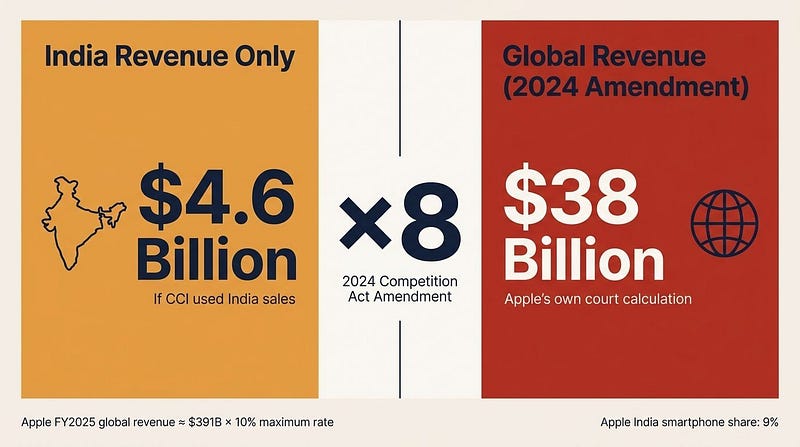
Also in 2024, India amended Section 27(b) of its Competition Act. The revision allows CCI to calculate penalties based on a company's global turnover, not just its revenue from India.
Apple's fiscal year 2025 global revenue: approximately $391 billion. At the statutory 10% maximum: $39 billion. Apple's own legal filing to the Delhi High Court put the maximum exposure at $38 billion.
Calculated on India revenue alone, the same penalty would be about $4.6 billion.
Same investigation. Eight times the difference, depending on which number you use as the base.
Apple's legal argument is that applying the 2024 amendment to a 2021 investigation is retroactive. CCI says it's a "clarification" of what the law always meant. You can decide which framing you find more credible.
Apple in India: 9% of the market
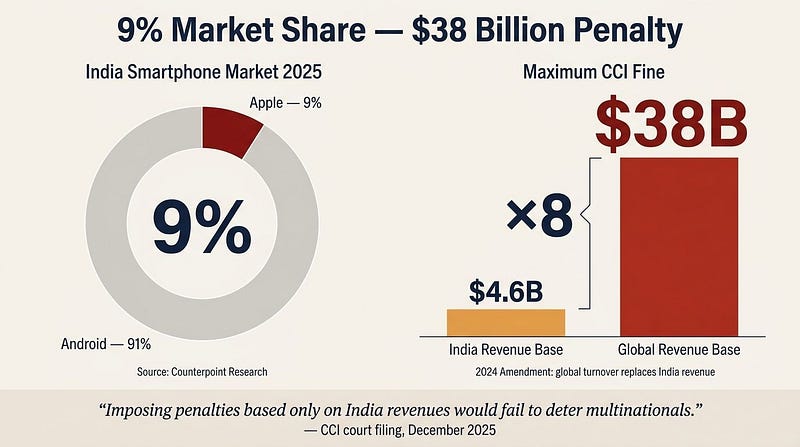
Apple's smartphone market share in India is 9%. Android holds 91%.
CCI's December 2025 court filing addressed this directly:
“Imposing penalties based only on India revenues would fail to deter multinational companies.”
So whether you hold 9% or 90% of a market doesn't determine whether you face deterrent-level fines. Your total global wealth does. Any company CCI designates as an "unavoidable trading partner" faces the same calculation, which is part of why this case is being watched beyond Apple's immediate situation.
Nokia left. Google paid. Vodafone won and still lost.
Google's run-in with CCI in October 2022 consisted of two parts: a $1.62 billion ruling for Android market abuse and a $1.13 billion ruling for Play Store policies, both in the same month. Google accepted both, made required concessions to its app distribution practices, and the total settlement came to around $468 million after reductions.
Vodafone's case is more instructive. After Vodafone acquired Hutchison Essar in 2007 for $11 billion, India's Revenue Department pursued capital gains tax on the deal. Vodafone fought it to the Supreme Court and won in 2012. India's response was to amend the tax code retroactively to 1962, specifically to reverse the ruling. International investors started calling it "tax terrorism." A 2020 arbitration tribunal sided with Vodafone. India eventually backed down, but only after years of proceedings and considerable reputational damage abroad.
Cairn Energy ran into the same retroactive tax framework and went to The Hague. The Permanent Court of Arbitration ordered India to pay Cairn $1.23 billion. Cairn then moved to freeze Indian government assets in France and filed proceedings against Air India in New York. India repealed the retroactive provisions in 2021 and settled.
Nokia's story is shorter. In 2013, Indian tax authorities froze Nokia's manufacturing plant assets mid-deal as Nokia sought to sell the plant to Microsoft. The dispute made the asset impossible to transfer. Nokia closed the factory and left.
Mastercard lost its ability to issue new cards in India in 2020, after the central bank blocked it over data localization requirements. The ban held for two years.
In 2022, India's Enforcement Directorate froze $725 million from Xiaomi, and executives were arrested. Those assets are still frozen.
American, British, Finnish, Chinese. Different industries, different charges, same general trajectory.
The playbook
Looking across these cases, the structure is recognizable.
An investigation opens — antitrust, tax, money laundering. The specific charge matters less than establishing jurisdiction and putting the company in a reactive position.
If the law doesn't produce the outcome the government is seeking, it gets amended. Vodafone's win at the Supreme Court triggered a retroactive tax amendment going back to 1962. Apple's investigation, which reached a penalty ceiling based on India revenues, triggered the 2024 global revenue amendment.
Suppose international arbitration overturns the outcome, India delays. Both Vodafone and Cairn won at international tribunals and then spent years waiting for enforcement.
Eventually, the company makes a choice: pay, litigate for years, or leave. Google paid. Nokia left. Apple is currently challenging the legal framework in the Delhi High Court.
2,783 companies
Between 2014 and 2021, 2,783 foreign companies closed their operations in India, according to India's own parliamentary filings. The count of foreign companies registered in India dropped from roughly 3,165 to around 1,600, roughly halved.
Ford exited in 2021. GM left in 2017. Harley-Davidson pulled out in 2020. None of these were forced exits. They were companies calculating whether the market was worth the complexity.
Will Apple actually pay $38 billion?
Almost certainly not at that number.
The $38 billion is the theoretical maximum. CCI has discretion over the actual penalty rate, and across comparable cases, the actual figures fall well short of the headline ceiling. Google's fines were significant but nowhere near the maximum.
Apple's Delhi High Court challenge directly targets the global revenue methodology. If the court rules that the 2024 amendment can't be applied to a 2021 investigation, the calculation resets to India revenues—around $4.6 billion, still substantial but a different order of magnitude.
There's also something worth noting: the $38 billion figure appears in Apple's own court filing. By computing and publishing the theoretical maximum, Apple is making a proportionality argument to the court and to anyone who reads the document: a penalty approaching 10% of global revenue, for a company with 9% market share in the fining country, says something specific about the methodology being applied.
What happens next depends on the court outcome. Apple could settle and make concessions — Google's path, which keeps India operations intact. It could litigate through to a ruling. Exiting is the least likely path given Apple's manufacturing investment: Foxconn and Tata have been expanding iPhone assembly in India, and Apple has publicly positioned that production as part of its supply chain diversification from China. Walking away from that investment would cost more than almost any fine.
The manufacturing contradiction
India is actively trying to attract electronics manufacturing. Apple has been working toward that goal in a fairly visible way — statements from Apple's leadership have identified India as a meaningful part of its future supply chain strategy.
I don't think this contradiction resolves neatly. Some read India's enforcement posture as the growing pains of a maturing regulatory system, likely to stabilize as India integrates further into global supply chains. Others point to the 2,783 companies that left between 2014 and 2021 and suggest that those companies had already run the calculation.
Apple's case will probably settle before it reaches a final ruling. But the underlying question — whether global revenue is a legally sustainable penalty base for a company with a single-digit local market share, under a law amended after the investigation began — doesn't disappear when one case closes. Other companies are reading this filing right now and doing their own math.
Sources: Reuters (April 20, 2026) | MediaNama | DigiTimes | Engadget | South China Morning Post | CCI official records | India Registrar of Companies | PCA arbitration ruling | Counterpoint Research