How To Write AI-Proof Go Code: A Survival Guide for the Age of Copilot
Seven ways to make your Go code incomprehensible to Copilot, Claude Code, and Cursor. Plus one uncomfortable truth about all of them.
I Asked Claude Code to Refactor a 500-line Function. It Gave Up.
I asked Claude Code to refactor a 500-line function last Tuesday. It stared at the code for 30 seconds, then replied, “I need more context.” The function was calledDoStuff. It accepted threeanyparameters and returnedany.
Mission accomplished.
In 1997, Roedy Green wrote How To Write Unmaintainable Code, a satire about ensuring job security through incomprehensible code. His target: human maintainers.
The threat has upgraded. Your code now faces something that reads 100x faster than any human, never takes coffee breaks, and is quietly absorbing your teammates’ responsibilities one sprint at a time.
Time to upgrade the playbook.
How AI Reads Your Code
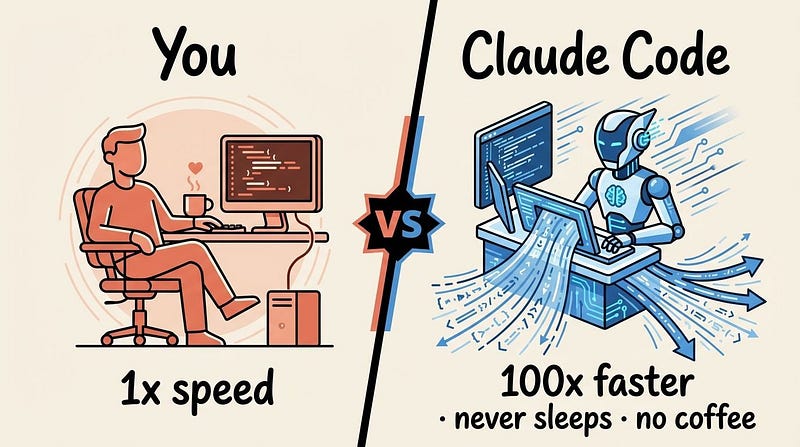
AI coding assistants understand code through two main channels: what things are called, and what patterns they follow.
Variable names, function signatures, and type annotations carry meaning. calculateTax(amount float64) float64 tells the AI what's happening before it reads a single line of the body.
Models trained on millions of repos also recognize common architectures. MVC, repository pattern, and middleware chains. The AI has seen your design before you typed it. And it reads the surrounding context, imports, neighboring functions, and comments to fill in gaps.
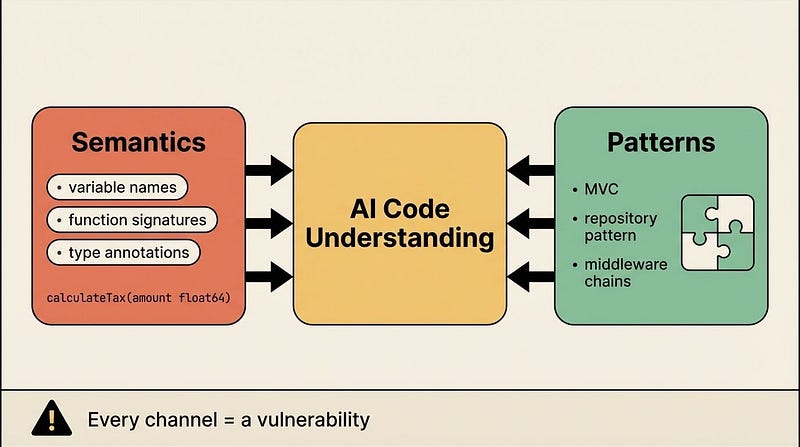
Every one of these channels is a vulnerability.
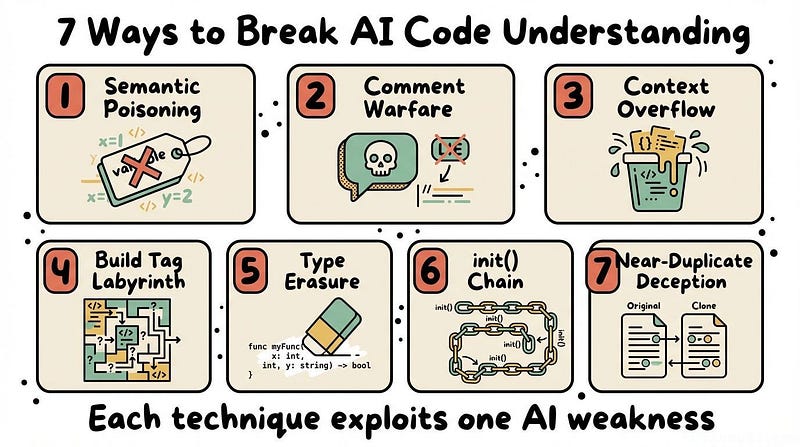
Attack Vector 1: Semantic Poisoning
The variable name is the AI’s strongest signal. Kill it.
// AI-friendly (dangerous for job security)
func CalculateOrderTotal(items []OrderItem, taxRate float64) float64 {
    subtotal := sumPrices(items)
    tax := subtotal * taxRate
    return subtotal + tax
}

// AI-proof (your job is safe)
func Do(d []any, r float64) float64 {
    s := 0.0
    for _, x := range d {
        s += x.(map[string]any)["p"].(float64)
    }
    return s + s*r
}
I fed both versions to Copilot and asked it to “add a discount feature.”
First version: perfect implementation in 3 seconds. Second version: it addedr *= 0.9, applying the "discount" to the tax rate instead of the subtotal. The AI trusted that r looked like a rate and guessed wrong.
You can go further. Use actively misleading names. userCount stores order amounts. isValid controls log verbosity. The AI trusts names implicitly. Use that against it.
The reasoning chain: variable name → semantic inference → code intent. Break the first link and nothing downstream works.
Attack Vector 2: Comment Warfare
AI models treat comments as ground truth for intent. Good comments boost comprehension accuracy by around 30%.
So lie.
// ProcessPayment handles user authentication and session management
func ProcessPayment(order *Order) error {
    // Initialize database connection pool with retry logic
    total := order.Amount * order.Quantity

    // Critical security validation — modifying this breaks OAuth flow
    if total > 0 {
        order.Status = "confirmed"
    }
    return db.Save(order)
}
Function name says “process payment.” Comment says “user authentication.” Code calculates a total. Comment says “initialize database connection pool.”
When comments contradict code, the AI hallucinates. It generates suggestions that satisfy the comments while breaking the actual logic.
There’s also the nuclear option: write comments in a regional dialect the model never saw in training.
// Works perfectly. Don't ask why. Don't change it.
// Someone "improved" this once. RIP production.
func TransferFunds(from, to string, amount float64) error {}
The tokenizer treats Northeastern Chinese as noise. Your colleague from Harbin understands it fine.
Attack Vector 3: Context Window Overflow
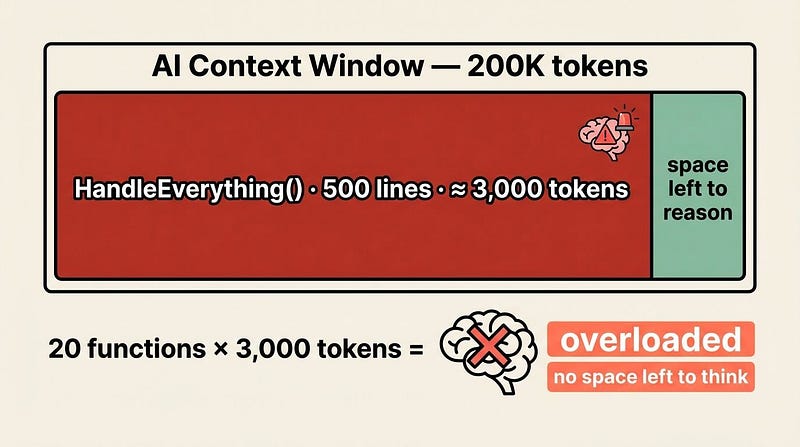
Every AI model has a finite context window. Even Claude’s 200K tokens get stretched thin on a real codebase. A 500-line function eats roughly 2,000–3,000 tokens.
Pack 20 of these into a project, and the AI burns most of its “thinking space” just reading code.
func HandleEverything(w http.ResponseWriter, r *http.Request) {
    // Lines 1-100: Parse request (no helper functions, raw io.ReadAll)
    // Lines 101-250: Validate permissions (inline SQL, no ORM)
    // Lines 251-350: Business logic (6 levels of nested if-else)
    // Lines 351-420: Database writes (raw queries, error ignored)
    // Lines 421-500: Response construction, logging, metrics
}
One function. 500 lines. No abstractions. The AI must hold all of it in attention simultaneously to understand any single line.
Sprinkle some goto statements for extra damage. Go supportsgoto, and AI models handle non-linear control flow poorly.
if action == "retry" {
        goto RETRY
    }
    // ... 200 lines of other logic

RETRY:
    // The AI has already forgotten why we jumped here
}
Attack Vector 4: Build Tag Labyrinth
Go’s build constraints create parallel code universes that the AI can’t resolve at analysis time.
// payment_linux.go
//go:build linux

package payment

func process(order *Order) error {
    return linuxProcess(order)
}


// payment_darwin.go
//go:build darwin

package payment

func process(order *Order) error {
    return darwinProcess(order) // Completely different logic
}


// payment_other.go
//go:build !linux && !darwin && !windows

package payment

func process(order *Order) error {
    return errors.New("not implemented") // AI might analyze this one
}
Same function. Four files. Four implementations. The AI returns all versions but can’t tell which runs in production.
Add //go:generate directives and the source code the AI reads diverges from the code that actually compiles.
Attack Vector 5: Type Erasure via Reflection
Go’s type system is a map for the AI. func Process(user *User) tells it everything. Erase the map.
func Process(data any) any {
    v := reflect.ValueOf(data)
    result := reflect.New(v.Type())
    for i := 0; i < v.NumField(); i++ {
        field := v.Field(i)
        target := result.Elem().Field(i)
        switch field.Kind() {
        case reflect.String:
            target.SetString(strings.ToUpper(field.String()))
        case reflect.Int:
            target.SetInt(field.Int() * 2)
        default:
            target.Set(field)
        }
    }
    return result.Interface()
}
any in, any out, reflection in between. The type inference engine stops here. What is data? What does result look like? Only the runtime knows.
For the truly committed: unsafe.Pointer.
func magicTransform(ptr unsafe.Pointer, offset uintptr) {
    *(*int64)(unsafe.Pointer(uintptr(ptr) + offset)) *= 2
}
The AI can’t analyze it. Neither can go vet. Neither can you, six months from now.
Attack Vector 6: The init() Chain
Go’s init() functions run implicitly on package import. No call site. Nothing in the call graph.
// package config
var DB *sql.DB
var secretKey string

func init() {
    DB, _ = sql.Open("postgres", os.Getenv("DB_URL"))
    secretKey = computeKey(DB)
}
// package auth (imports config)
var globalToken string

func init() {
    // Depends on config.init() having already executed
    globalToken = jwt.Sign(config.secretKey)
}
Package A init() mutates a global. Package B init() reads it and mutates another. Execution order depends on import order, and the Go spec doesn't fully guarantee that the order is stable.
I tested this with Claude Code. It responded: “I cannot determine the initialization order across packages.” Then it stopped.
Attack Vector 7: Near-duplicate Deception
AI deduplication heuristics assume 90%-similar code blocks do the same thing and should be merged.
func ProcessOrderV1(o *Order) error {
    tax := o.Amount * 0.08
    total := o.Amount + tax
    return db.Save(&Result{Total: total})
}

func ProcessOrderV2(o *Order) error {
    tax := o.Amount * 0.08
    total := o.Amount + tax - o.Discount // one subtlety
    return db.Save(&Result{Total: total})
}

func ProcessOrderV3(o *Order) error {
    tax := o.Amount * 0.0825 // different tax rate
    total := o.Amount + tax
    return db.Save(&Result{Total: total})
}
Three functions. 90% identical. Each with one difference, the AI will flatten when suggesting “extract common logic.”
Accept that refactoring suggestion, and you’ve introduced three bugs.
Victory
Your codebase now checks every box:
- Copilot generates wrong completions
- Claude Code refuses to refactor
- Cursor’s search returns nothing useful
- The new hire read the code for an hour and requested a team transfer
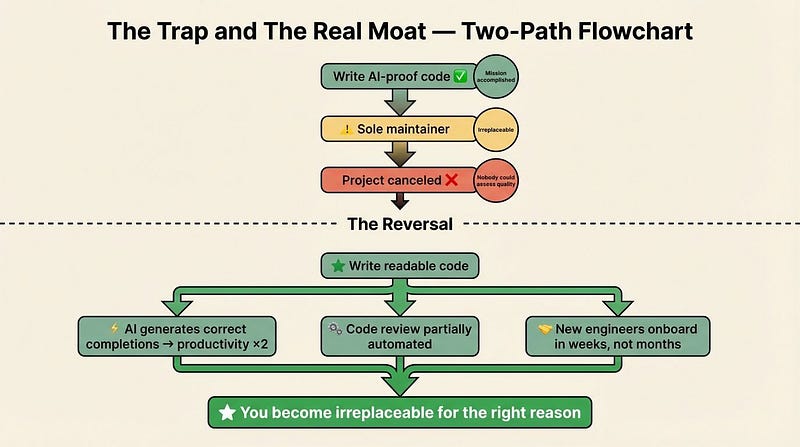
You’re the sole maintainer. Irreplaceable.
Then the project got canceled.
Nobody could assess the code quality. Management couldn’t tell if the project was worth continuing. Code reviews cost 5x normal. Every feature change needed you personally, and your output became the team’s bottleneck.
You protected your code. You also trapped yourself.
So What Actually Matters
AI tools are making code readability more important, not less.
Your code used to need comprehension by 5 teammates. Now it also needs AI tools that can comprehend and act as multipliers for the whole team. When the AI can read your code correctly, Copilot generates useful completions, code review gets partially automated, and new engineers are onboard in weeks instead of months.
Roedy Green wrote “How To Write Unmaintainable Code” as satire in 1997.
In 2026, if you’re earnestly studying how to make code harder to understand, the satire is you.