He Invented the Operating System for the PC — The Winners Were a Pack of “Thieves”
He Invented the Operating System for the PC — The Winners Were a Pack of “Thieves”. IT HISTORY He Invented the Operating System for the PC — The Winners We。
IT HISTORY
He Invented the Operating System for the PC — The Winners Were a Pack of “Thieves”
The system call table he printed in a public manual, and the DOS someone else wrote from it
In 1974, in Pacific Grove, California, Gary Kildall slid an 8-inch floppy disk into a microcomputer at home. The machine was running a program he had written himself — a command line, a way to list files, a way to move through directories. He called it CP/M, Control Program for Microcomputers.
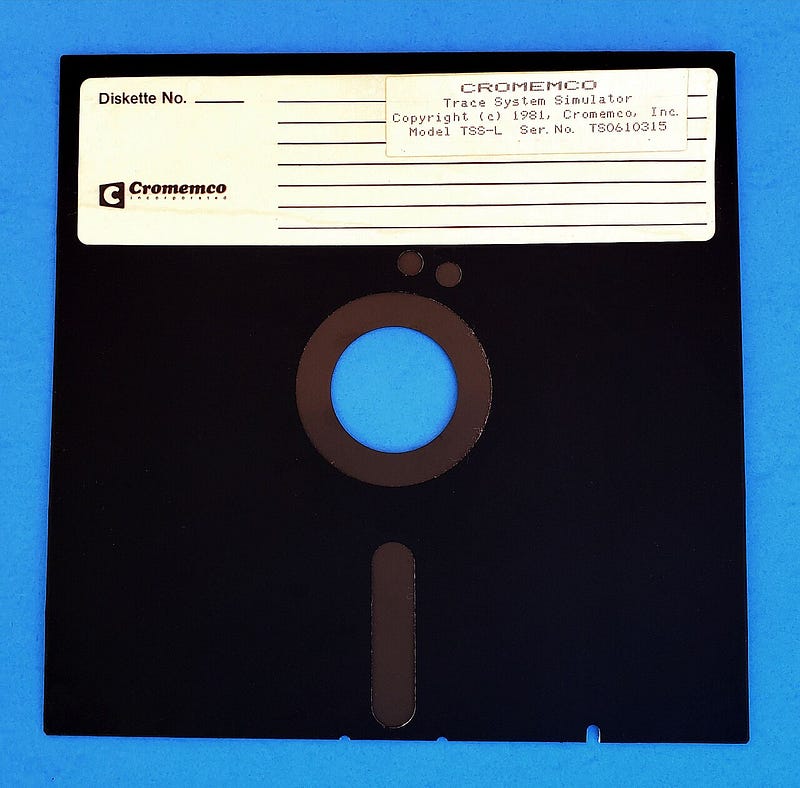
The next two years were the golden age of the microcomputer. Dozens of companies appeared. Altair, IMSAI, Cromemco — they had one thing in common: the chip was Intel’s 8080, or something compatible with it. The disk controllers, though, came from all over, and every vendor picked its own serial port addresses.
By rights, each of those machines should have needed its own software.
CP/M did not have that problem. It kept the code that talked to hardware in its own layer, called the BIOS. Above that, the part handling files and the command line was a compiled binary, identical on every machine. A vendor who wanted CP/M running on its hardware did not have to touch that binary. It only had to implement the BIOS.
So the one program Kildall wrote could fit dozens of machines. By 1981, CP/M was running on more than 3,000 models.
The machine that mattered most that year was not one of them. The IBM PC shipped with a system a programmer in Seattle had written from Kildall’s own published manual. Kildall called it plain and simple theft for the rest of his life.
He Taught for a Living
Kildall’s day job was teaching computer science at the Naval Postgraduate School. On the side, he consulted for Intel, wrote them an assembler for the 4004, and later built the PL/M compiler. Back then you fed a program to a microprocessor on punched paper tape. Change one byte and the whole tape had to be punched again.
The compiler was where it hurt. It kept growing until a single tape could not hold it. Around 1972, Kildall got hold of an 8-inch floppy drive and started working out how to make the 8080 load programs straight off it.
Inside a Victorian House in Pacific Grove
In 1974, he and his wife, Dorothy McEwen, started a company. The first name was Intergalactic Digital Research; later it became Digital Research. Their children described the couple this way in the introduction to his memoir:
“You will read how Gary and Dorothy started from modest means as a young married couple, paved a new path for start-up culture, and embraced their idea of success to become leaders in the industry.”
Kildall wrote the code. Dorothy ran the sales side. In 1978, the company was taking in $100,000 a month; in 1981, $5.4 million for the year; by 1983, $44.6 million.
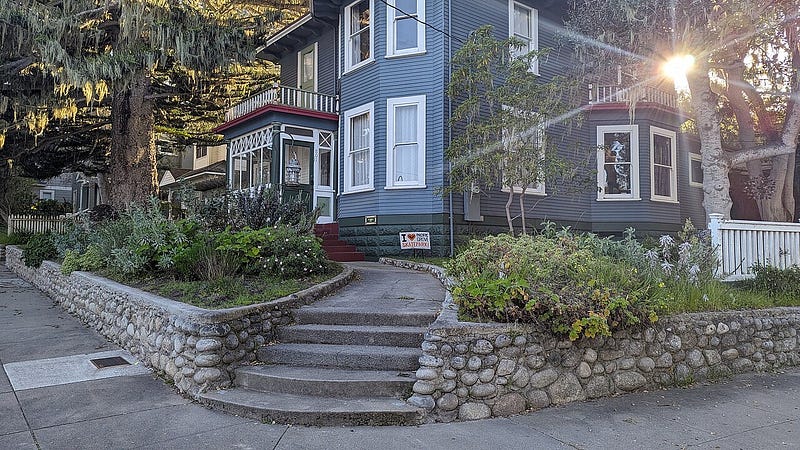
Digital Research’s headquarters was that Victorian house in Pacific Grove. The company never raised money and never planned to go public. The income was all CP/M royalties.
In 1980, IBM came.
The Afternoon With IBM
IBM was building a personal computer and needed an operating system, so they came to Digital Research. The reason was simple: if you wanted a microcomputer operating system you could use as-is, you couldn’t get around CP/M.
The version of that meeting that spread widest goes like this. Kildall spent the day flying his own small plane on a delivery, missed the negotiation that would have changed history, and IBM went to Microsoft instead. People still repeat it.
It is not true. In 2016, when the Computer History Museum released Kildall’s memoir, his children Scott and Kristin took the story apart in the preface:
“Those who have heard of him may recall the myth that he ‘missed’ the opportunity to become Bill Gates by going flying instead of meeting with IBM. Unfortunately, this tall tale paints Gary as a ‘could-have-been.’”
Kildall was a pilot, and flying did often make him late. But the talks broke down that day over three specific things.
- The NDA never got settled. IBM wanted Digital Research to sign one and would not sign a matching one itself.
- Then there was how the money worked. Digital Research lived on royalties, collecting on each machine sold; IBM wanted to buy the software outright for a flat fee and rename it on top of that.
- Last was the delivery date. IBM wanted the 16-bit CP/M-86, and Digital Research would not commit to a ship date.
So the meeting went nowhere. IBM turned around and went to Seattle, where it later handed Bill Gates a very large order.
A Manual Anyone Could Buy
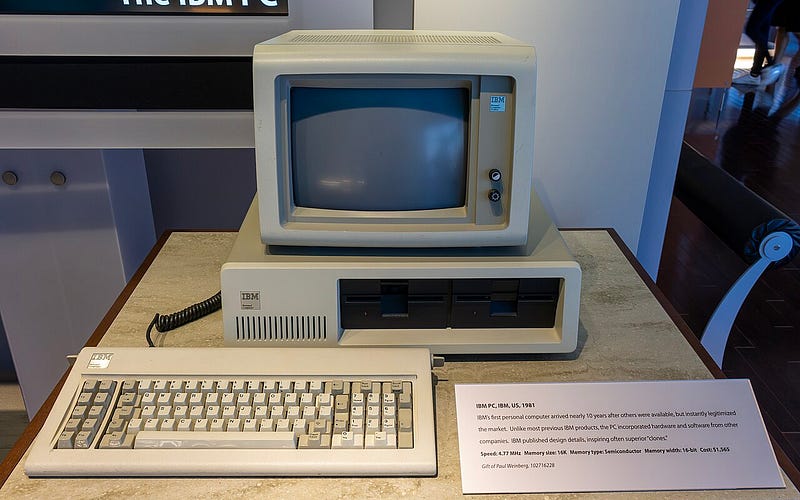
IBM went to a small company in Seattle called Seattle Computer Products. A programmer there named Tim Paterson. Starting in April 1980, working alone from the published CP/M manual, he wrote a system with a closely compatible API. Its first name was QDOS, Quick and Dirty Operating System.
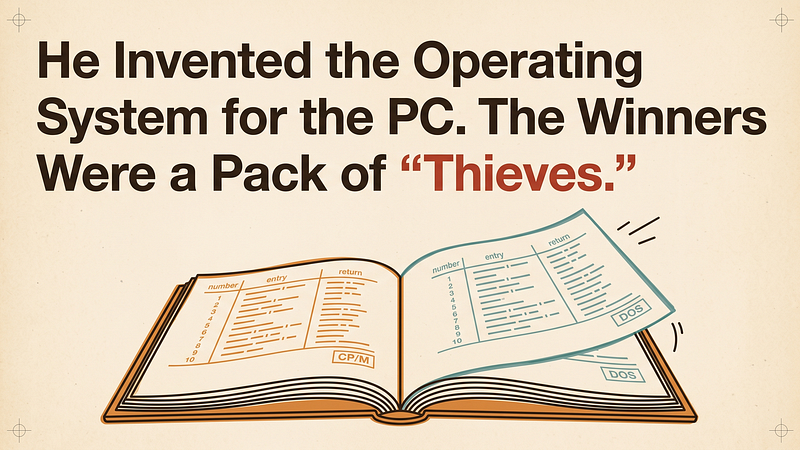
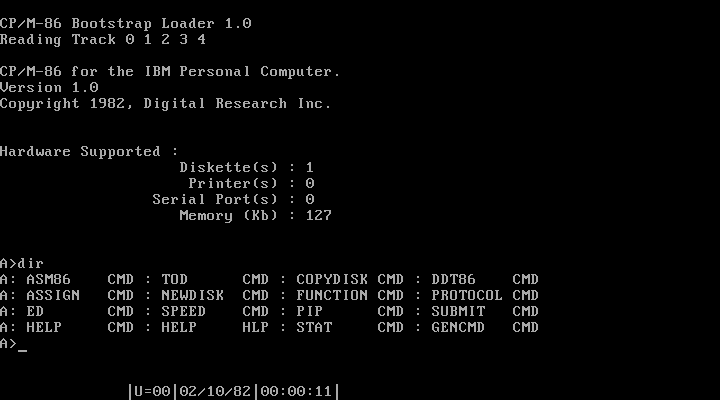
Kildall wrote that manual himself to make his system easier to pick up. It laid out the number, the entry parameters, and the return values for every system call. Write from that manual, and you get a system that is called in exactly the same way.
In December 1980, Microsoft bought a non-exclusive license to QDOS for $25,000. In July 1981, it bought the rights outright for somewhere between $50,000 and $75,000, hired Paterson away in the process, and had him port the system to the 8088 the IBM PC used. That system became known as MS-DOS.
When the IBM PC shipped, MS-DOS listed at $40. CP/M-86 listed at $240.
In his memoir, Kildall did not soften it. What Paterson wrote, he called:
“plain and simple theft”
In an appendix, he printed the CP/M and DOS code side by side and said the first 26 calls were word-for-word identical. Paterson’s account is that he reimplemented it from the published manual, which is not copying. Both sides have said their piece, and to this day neither version is one the other will accept.
An Ending Without a Period
In 1991, Novell bought Digital Research. Kildall had mostly stopped running the company by then: teaching, flying, hosting a television show about personal computers called Computer Chronicles.
On July 8, 1994, in a bar in Monterey, he fell backward and hit his head on the floor. Three days later, he died at Community Hospital of the Monterey Peninsula, at 52. The autopsy said the cause was blunt force trauma to the head, and also found evidence of a heart attack. He did have a drinking problem in his last years.
His sister, Patricia Guberlet, put it this way:
“We all thought Gary was a genius. He was a genuinely likable person.”
His cousin Tom Kildall was flatter about it:
“He paved the way for everybody. That’s the way it goes.”
The year before he died, he wrote a memoir, Computer Connections, had it bound, and sent it to family and friends with a note: it would be published in final form the following year.
That never happened.
One passage is about Bill Gates:
“I have grown up in the industry with Gates. He is divisive. He is manipulative. He is a user. He has taken much from me and the industry.”
What stopped me was the line after it. He admits the words are “sour grapes,” and then insists they are also “the whole truth.”
In 2016, with his children’s permission, the Computer History Museum released the first part of the manuscript. The second part is still closed for family privacy.
What he settled on is still here. The firmware on your motherboard is still called the BIOS, and the split that separates the system from the hardware was his idea first; follow Windows and DOS back far enough, and you reach QDOS, and past that, CP/M.
Other people took his code and built another system from it, took his manual and filled in the details. Of what he wanted to say himself, only half survives.
Support writers. All our nonprofit’s offerings here.
Click here to subscribe to the IT Chronicles newsletter.
Click for Wordsmith, Mystery Writing, Write Like Stephen King, more