Go 1.27 Finally Flattens Struct Literals — Goodbye to Nested Boilerplate
How Promoted Fields in Go 1.27 Eliminate Russian-Doll Initialization Without Sacrificing Type Safety

GOLANG
Go 1.27 Finally Flattens Struct Literals — Goodbye to Nested Boilerplate
I spent an hour refactoring our configuration package after upgrading to Go 1.27, and deleted 420 lines of redundant struct wrappers in a single pass. For sixteen years, Go forced an annoying double standard: once an embedded struct was defined, we could read its fields with plain dot notation, yet constructing that same struct required wrapping every embedded type in a Russian nesting doll.
Go 1.27 resolves this long-standing asymmetry. Promoted fields from anonymous embedded structs can now serve as keys in composite struct literals.
The change stems from proposal #9859, an issue opened back in 2015. It looks small on paper, but in production codebases packed with configs, DTOs, and test fixtures, it removes an entire category of syntactic noise.
Field promotion had a double standard
Consider a standard domain model with two reusable building blocks, Address and Contact:
type Address struct {
    City  string
    State string
}

type Contact struct {
    Email string
    Phone string
}

type Employee struct {
    Name string
    Age  int

    Address // anonymous embedding
    Contact // anonymous embedding
}
Go developers rely on field promotion every day. Because Address and Contact are embedded anonymously, their fields elevate to Employee:
Address.City
Address.State

Contact.Email
Contact.Phone
When reading an instance, we have always accessed those fields without extra qualification:
e.City
e.State
e.Email
e.Phone
Yet initializing that same instance told a different story. Even though City was already promoted on Employee, the compiler refused to accept City: "NYC".
Before Go 1.27 — the nesting doll tax
Prior to Go 1.27, initializing Employee required spelling out each embedded type name:
e := Employee{
    Name: "Alice",
    Age:  30,
    Address: Address{
        City:  "NYC",
        State: "NY",
    },
    Contact: Contact{
        Email: "[email protected]",
        Phone: "555-0100",
    },
}
The hierarchy looks neat in an architectural diagram:
Employee
├── Name
├── Age
├── Address
│   ├── City
│   └── State
└── Contact
    ├── Email
    └── Phone
In source code, it created genuine friction. You had to type Address: Address{ and Contact: Contact{, repeating type names and indenting fields across multiple levels. If your struct nested three layers deep, your code drifted to the right margin.
Go 1.27 flattens construction
Go 1.27 allows promoted fields to act as literal keys:
e := Employee{
    Name:  "Bob",
    Age:   25,
    City:  "LA",              // promoted from Address
    State: "CA",              // promoted from Address
    Email: "[email protected]", // promoted from Contact
    Phone: "555-0200",        // promoted from Contact
}
The snippet drops from 12 lines to 8, a 33% reduction with zero loss in clarity.
This is not cosmetic sugar. It aligns Go’s mental model across read and write operations. If you read a value with e.City, initializing it with City: "LA" feels natural and cohesive.
Configuration structs gain information density
In real-world services, configuration structs suffer the most from nested syntax. Take a typical application config embedding database and cache settings:
type DatabaseConfig struct {
    Host     string
    Port     int
    Name     string
    SSL      bool
    MaxConns int
}

type CacheConfig struct {
    TTL     int
    MaxSize int
}

type AppConfig struct {
    DatabaseConfig // anonymous embedding
    CacheConfig    // anonymous embedding
}
Under older Go releases, initializing AppConfig felt heavy because structural wrappers obscured the actual data:
c1 := AppConfig{
    DatabaseConfig: DatabaseConfig{
        Host:     "localhost",
        Port:     5432,
        Name:     "mydb",
        SSL:      true,
        MaxConns: 100,
    },
    CacheConfig: CacheConfig{
        TTL:     300,
        MaxSize: 256,
    },
}
The visual weight centered on enclosing types rather than values. Readers wanted to inspect settings like Host, Port, and TTL, but first had to parse multiple layers of structural wrappers.
Go 1.27 flattens this declaration into a clean key-value block:
c2 := AppConfig{
    Host:     "localhost", // from DatabaseConfig
    Port:     5432,        // from DatabaseConfig
    Name:     "mydb",      // from DatabaseConfig
    SSL:      true,        // from DatabaseConfig
    MaxConns: 100,         // from DatabaseConfig
    TTL:      300,         // from CacheConfig
    MaxSize:  256,         // from CacheConfig
}
The initialization shrinks from 14 lines to 9, saving 36% of screen real estate. More importantly, information density increases: you spot the configuration values instead of structural plumbing.
Flattening two levels deep
The ergonomic benefit becomes even more pronounced when embedding spans multiple layers:
type Coordinates struct {
    Latitude  float64
    Longitude float64
}

type Location struct {
    Coordinates // depth 1
    Altitude    float64
}

type Site struct {
    Name     string
    Location // depth 2
}
In Go 1.26, you had to write out each nested level:
s := Site{
    Name: "Data Center",
    Location: Location{
        Coordinates: Coordinates{
            Latitude:  40.7128,
            Longitude: -74.0060,
        },
        Altitude: 10.5,
    },
}
In Go 1.27, all intermediate wrappers disappear into flat assignments:
s := Site{
    Name:      "Data Center",
    Latitude:  40.7128,
    Longitude: -74.0060,
    Altitude:  10.5,
}
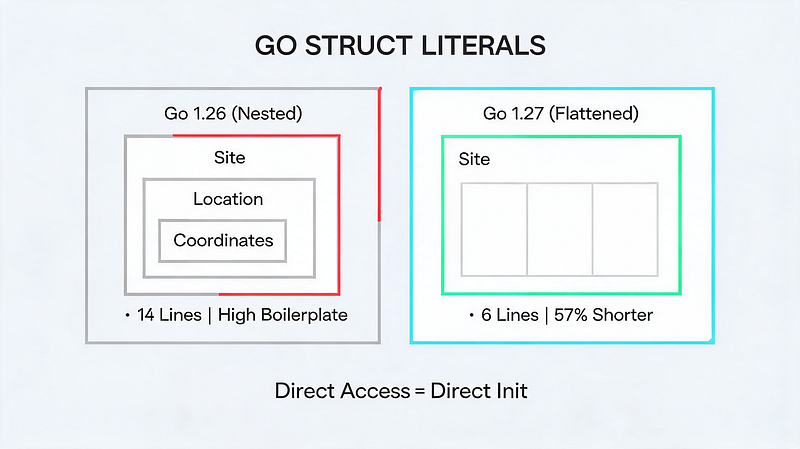
This compresses a 14-line declaration into 6 lines, delivering a 57% reduction. It also proves keyed fields are not restricted to single-level embedding: any field that elevates unambiguously under Go’s existing promotion rules can serve as an initialization key.
Ambiguity — when the compiler refuses to guess
Flattened initialization requires the promoted field name to be unambiguous. Suppose both embedded structs share a common field:
type DatabaseConfig struct {
    Host string
    Port int
}

type CacheConfig struct {
    Host string
    TTL  int
}

type AppConfig struct {
    DatabaseConfig
    CacheConfig
}
If you attempt to write a flat key for Host:
c := AppConfig{
    Host: "localhost",
}
The Go compiler rejects it with a clear diagnostic:
./main.go:20:3: unknown field Host in struct literal of type AppConfigBecause Host exists at the same depth in both DatabaseConfig and CacheConfig, Go's promotion rules do not elevate it to AppConfig. The compiler treats it as unknown, refusing to guess which sub-struct should receive the value.
In ambiguous cases, you fall back to explicit nested literals:
c := AppConfig{
    DatabaseConfig: DatabaseConfig{
        Host: "db.internal",
        Port: 5432,
    },
    CacheConfig: CacheConfig{
        Host: "cache.internal",
        TTL:  300,
    },
}
Refusing to guess in ambiguous cases preserves Go’s core design philosophy.
A strict guardrail against split initialization
During local testing with the Go 1.27 toolchain, I uncovered another strict compiler rule: Go prohibits mixing promoted fields with their enclosing embedded struct literal.
Suppose you attempt to initialize one field via the embedded struct and another field via promotion:
c := AppConfig{
    DatabaseConfig: DatabaseConfig{Host: "localhost"},
    Port:           5432, // promoted from DatabaseConfig
}
The compiler halts with an explicit error:
cannot specify promoted field Port and enclosing embedded field DatabaseConfigEven when Host and Port do not overlap, Go forbids split initialization across boundary layers. You either initialize the embedded struct explicitly, or initialize its promoted fields from the outside. You cannot do both at once.
Automated migration with embedlit
You do not need to rewrite legacy composite literals by hand. Go 1.27 ships with a dedicated analyzer called embedlit built into go tool fix:
# Preview proposed simplifications across your package
go fix -embedlit -diff ./...

# Apply simplifications across source files
go fix -embedlit ./...
The embedlit analyzer detects composite literals where nested embedded type specifiers can be removed safely, modernizing your codebase while verifying no name collisions occur.
Knowing when to keep nesting
Flattened initialization should be your default, but it is not a rigid rule.
Consider a large configuration struct containing thirty distinct options:
type DatabaseConfig struct {
    // 30+ fields...
}
If a helper function only populates three database options, keeping the explicit wrapper often improves clarity:
c := AppConfig{
    DatabaseConfig: DatabaseConfig{
        Host: "db.local",
        Port: 5432,
        SSL:  true,
    },
}
The explicit type name groups those parameters together, telling the reader these three values belong to database connectivity rather than caching or metrics.
Shorter code does not always mean better code. Keyed fields eliminate structural boilerplate when grouping is redundant, but preserving explicit wrappers remains valuable when domain boundaries clarify intent.
Use flattened keyed fields as the sensible default. Fall back to nested structs when disambiguating collisions or highlighting specific domain boundaries.
Quiet improvements that compound
Go 1.27’s keyed fields feature does not transform runtime scheduling or overhaul the type system. It does something more practical for daily engineering: it eliminates years of repetitive boilerplate across configs, fixtures, and data transfer objects.
By aligning struct initialization with field access, Go makes its type embedding model more cohesive. The language offers a cleaner path forward without taking away explicit control when you need it.