Minitel Reached 25 Million People — Then Its Own Meter Killed It
Minitel Reached 25 Million People — Then Its Own Meter Killed It. IT HISTORY Minitel Reached 25 Million People — Then Its Own Meter Killed It When I first。
IT HISTORY
Minitel Reached 25 Million People — Then Its Own Meter Killed It
When I first read about Minitel, the number that stopped me was 25 million. A quarter of France’s population used an online world a full decade before the Web: train tickets, bank accounts, chat, news. Then France Télécom turned it off on June 30, 2012, with 810,000 terminals still plugged in.
The usual version of this story ends with “too early.” That misses the mechanism. Minitel reached national scale and still could not become the Web, because it charged by the minute. Attention itself had a meter on it, and a metered network works against its own growth.
25 million people, a decade before the Web
By 1996, Minitel carried 26,000 services built by roughly 10,000 companies. Terminals peaked at 9 million, and the platform reached about 25 million users out of a national population of about 60 million.
People checked bank accounts, booked SNCF tickets, and read the news. A chat service called 3615 rose carried much of the system’s revenue. In 1993, users logged more than 90 million hours on the network. None of this was a press release. It was a paid, daily online economy before Mosaic existed.
The people who missed it most were dairy farmers in Brittany. Around 2,500 of them had spent decades calling the inseminator through Minitel: a cow goes into heat, you dial a number, type a few keys, and someone shows up. Farm manager Solange Gieux put it this way:
“It’s heartbreaking for me. My Minitel was sacred. It was very simple to use and very inexpensive. It’s too bad they are taking a tool like this away from us.”
Why a free terminal mattered
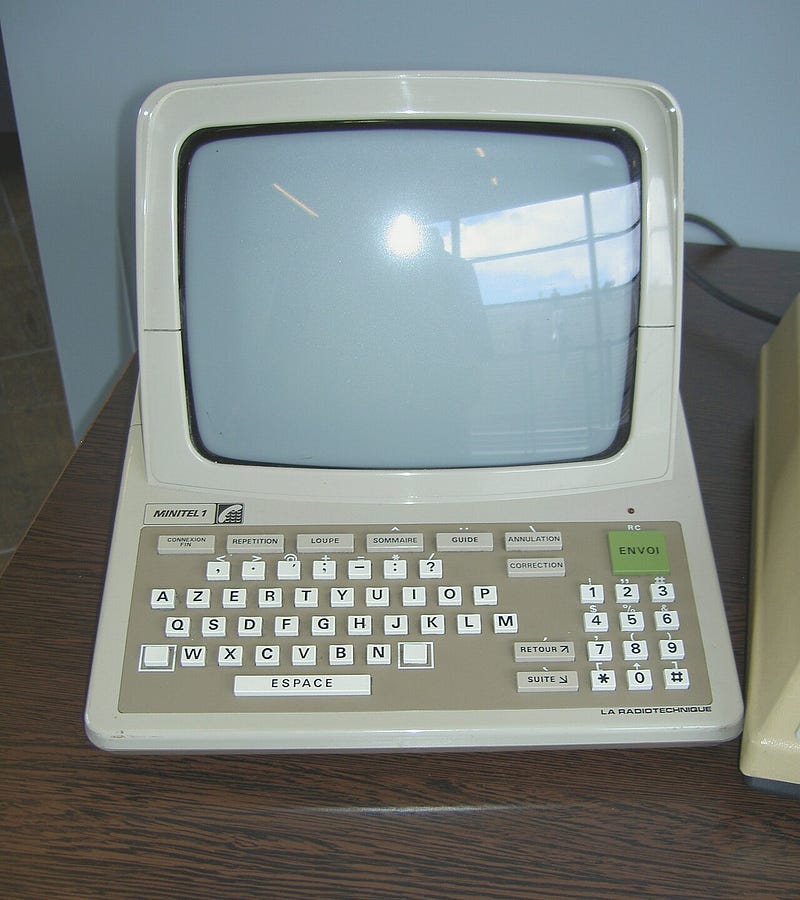
The origin explains the scale. France’s printed phone directory had to cover 12 million subscribers, and printing it cost more every year. So the state gave a free terminal to every household with a phone line. The electronic directory replaced the paper one, and the terminal rode into homes with it. The rollout ran through 1982 and 1983. Nobody signed up to go online. People just wanted to look up a phone number, and everything else grew on top of that base.
The Thomson videotex terminal used in the 1980 Vélizy Télétel trial — the pilot that preceded the national rollout. Photo by Bernard MARTI, CC BY 3.0, via Wikimedia Commons.
Metered attention
Minitel’s menu was controlled entirely by the server. You picked an option on one screen, and the server decided what came next. There were no hyperlinks, the protocol was not public, and a third-party service could not innovate without going through France Télécom.
Revenue worked the same way. France Télécom charged users by the minute, kept a third, and paid the rest to service providers. This was not a bug. It was the business model from day one: every minute cost money, which put a meter on attention itself.
An open network grows the more it is used, because anyone can link to any resource. A metered network runs the opposite way: the longer you stay, the more you pay, and the less reason you have to click further. A meter and a network effect pull in opposite directions. Minitel was scaled by the free terminal, then capped by the same meter that funded it.
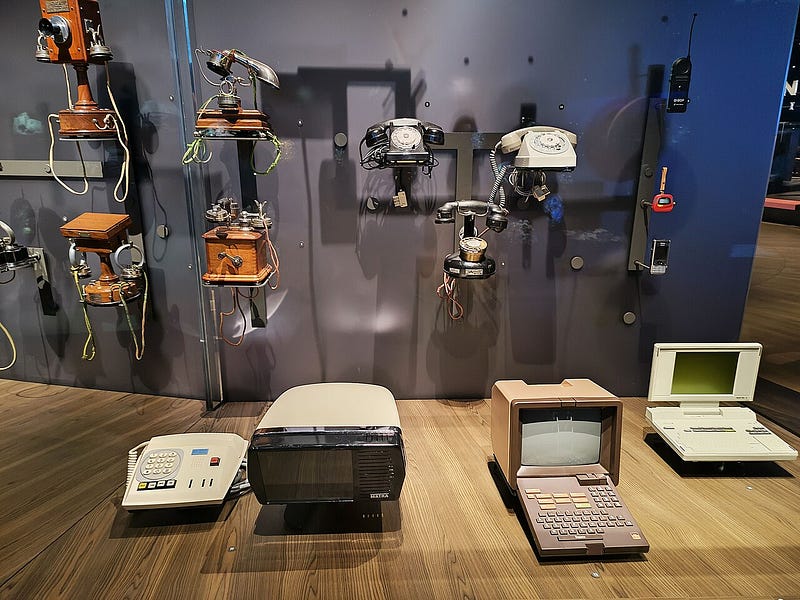
Even the terminal was locked into the same logic. France Télécom wanted it cheap, so beyond a small screen and a keyboard there was nothing to it and no room to grow.

101 Online couldn’t travel
France Télécom tried exporting the model to the US in 1991, launching 101 Online in the San Francisco Bay Area. It pulled out quickly. It had run straight into AOL, Prodigy, and the infant Web.
It died slowly
What followed was not a cliff. It was a loosening. In the late 1990s, France Télécom was partly sold to the market, and the telephone monopoly loosened with it. Dial-up got cheaper. Users drifted toward the Web.
In February 2009, with the iPhone already two years old, Minitel still logged 10 million connections a month. The real shutdown came on June 30, 2012, with 810,000 terminals still running.
What Maury got half right
Former Minitel project director Jean-Paul Maury put it this way:
“With the Minitel, we invented a lot of today’s technology. A terminal accessing a service located at the end of the world that was born with the Minitel: by that I mean the Internet and all online networks.”
I believe half of that. France really did prove the demand for an online world a decade early: commerce, chat, banking, news, all of it was there. But almost none of today’s biggest internet infrastructure companies were born in France. Gopher died of a licensing letter in eighteen months. Minitel died of its own meter over thirty years. Different pace, same verdict: a network that needs permission to grow cannot become the Web.
The meter was not a pricing detail. It was Minitel’s deepest assumption: that connectivity is a scarce good to be sold. The Web won by assuming the opposite, and by being free to link without asking anyone.
Support writers. All our nonprofit’s offerings here.
Click here to subscribe to the IT Chronicles newsletter.
Click for Wordsmith, Mystery Writing, Write Like Stephen King, more
By the EIC Susan Brearley with Ideogram