Deliberate Practice: The Path to Success and Genius
Deliberate Practice: The Path to Success and Genius. “Deliberate Practice” is not in many top book lists for no reason. Overall, it uses a lot of real data。

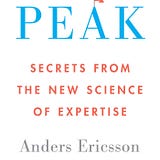
“Deliberate Practice” is not in many top book lists for no reason. Overall, it uses a lot of real data and detailed case details to elaborate on a fact: every successful person is the product of accumulated, deliberate practice, and no one is born a genius. “Genius” is the product of training. This breaks many childhood genius filters and many people’s brainwashing self-denial.
In this article, I want to summarize the significance of this book from a few points that touched me in this book. Before sharing, I want to confirm a few premises:
The success defined in this article is to become an outstanding person in a specific industry/field, such as: winning the highest award in the field, having famous works that have a global impact, etc. (I understand that this book also wants to express this meaning);
The concept in this article only represents personal understanding, that is, ten thousand readers have ten thousand Hamlets, seek common ground while reserving differences.
Is the 10,000-hour rule correct?
Many people should have heard of Gladwell’s 10,000-hour rule, which says, that as long as you study hard in any industry or field for more than 10,000 hours, you will succeed and become an outstanding person. But is this correct?
This concept is based on a large number of experiments conducted by the authors of this book, Anders and Robert, interviewing outstanding people in various industries, and even tracking surveys for several consecutive years, finding that all these outstanding people have invested a lot of practice time in their industry. Some are more than 8,000 hours, some are more than 9,000 hours, and some are about 11,000 hours. Because these data are summarized in a general way, that is the 10,000-hour rule. But the author states that this summary is also inaccurate, because the time required varies with the industry.
If you understand it superficially, as long as you meet the practice of 10,000 hours, you can achieve outstanding achievements, which is wrong. The reason why this concept is popular, in my understanding, is because complicated and boring experiments cannot arouse people’s interest. In the era of rapid development of information input and output, everyone can only grasp the eye-catching numbers and conflicting topics at a glance. Repeatedly practicing one thing, without planning, without breakthroughs, just mechanically completing the practice, is like crossing out one on 10,000 grids every hour, just to fill this one-hour practice, it can’t improve oneself, let alone Become an outstanding person. Practice makes perfect is not wrong, yes, it will make you feel more and more handy, but one day you will find that what you are doing now is no different from the previous day. If there is no clear plan to break through your comfort zone, you will always work in this proficient area, just to make yourself a more handy machine.
Time must be spent, but how to spend it is also very important, that is, if the goal is to succeed, you need to deliberately practice fully in these 10,000 hours.
How to practice deliberately?
At the beginning of the book, the author proposed “purposeful practice”. To sum up, purposeful practice has four characteristics: clear goals, focus, feedback, and breaking through the comfort zone. First of all, it is very important to set clear goals, have a plan and a purpose; focus on practice, and at the same time find a leader or mentor in a field (stage), collect feedback to correct yourself, and then continue to break through your comfort zone and continue to practice.
The author stated a concept in this book: mental representation, and three Fs: focus, feedback, and fix it. Simply put, mental representation, in my understanding, is a law that all outstanding people, whether intentionally or unintentionally, have summarized. It is a psychological structure that can improve logic. This is also part of deliberate practice. How to understand it? For example, I encountered problem A in my work, I recorded and summarized my method A (which can be understood as the initialization representation), so when I encounter a problem similar to A, problem B, I will first apply this method A, but it may not be able to complete problem B, I will try to summarize again, optimize method A to scheme A+ (advanced version of the representation), or break through to method B, and then precipitate and summarize, and so on. An outstanding person will have many such representations, because it is not about recording with a pen, it is a unique psychological structure that naturally forms in continuous breakthrough attempts, defined by the author as “mental representation”.
These mental representations should be logically self-explanatory, and at the same time they should be effective and concise. If you create this kind of mental representation, it should actually be completed through the three Fs mentioned above, that is, focused high-intensity practice, timely feedback collection, and timely correction. This is a cycle but it should not be a long cycle. I understand that it should be a short and fast cycle. Multiple short and fast practice cycles occur repeatedly and practice repeatedly. This is the correct way of deliberate practice.
I was born incapable/I have no talent?
People around always say that I have no talent for singing, I can’t learn musical instruments without talent, I was born mathematically incapable, these self-determinations about talent, are all clearly denied in this book. The book uses a large number of outstanding cases with names and evidence to state that unless there are genetic and physiological defects, the qualifications of every normal person are the same. No one is more talented than anyone. These so-called “I have no talent” concepts are actually brainwashing themselves, telling themselves that I can’t do it, and the fact is indeed not.
The author uses the case of an old man starting to learn Taekwondo at the age of 70 and aiming to become a black belt in Taekwondo, to state that anyone can achieve it if they want to do something, as long as they practice deliberately. The limitation of age or physical strength is reflected in the fact that if you start deliberate practice from childhood, it may take about 10 years to achieve outstanding achievements, but if you start deliberate practice from middle age, it will take 15–20 years. This also explains why early childhood education is important. The earlier the habit of deliberate practice is formed, the earlier and relatively easier it will be to succeed. But it does not mean that you will not succeed if you start now. The author stated from a scientifically rigorous perspective that as long as you continue to practice deliberately, you will significantly distance yourself from the people around you. Of course, the plans set by each person, specific industry fields and the time for feedback and repair are different, and the time to achieve will also vary.
Postscript
Actually, I was not a person who liked to read this type of book before. I was crazy about novels and various magazine articles in elementary and middle school, and rarely read this kind of rigid success study books; but now I am actually fascinated by this book. This is why I said at the beginning, maybe this is what time wants to teach us. Reading this book really made me feel deeply. Later, I pondered it over and over again, and understood that for me, this book is actually a case record book. A large number of case facts have confirmed the concept that I have always believed in, and have produced a strong resonance: as long as you practice correctly, anyone can be a genius; as long as you dare to think and do, clearly want to make outstanding achievements in a specific field, now is the earliest start time.
However, I did not do a good job of deliberate practice. To be precise, I believe in these concepts, but before reading this book, I didn’t think about many details. For example, I didn’t think it was a problem that I didn’t have a life mentor along the way. After reading this book, although my cognition is correct, I haven’t done many details and many systematic practice methods. Now I can take steps with clear thinking. So I really hope that this book can truly help you who want to break through your abilities, you who want to educate geniuses, and you who want to become the person you want to be. There are too many valuable views, ways to break through oneself, and even complete education methods and systems in the book. As the author of this book said, I have written the way to success for you in order, and you just need to do it, and you will definitely succeed. It is really worth reading carefully, the most important thing is to start using it in your life and work.