Dan Bricklin Invented the Spreadsheet — Then Spent Forty-Seven Years on the Same Idea
From VisiCalc to low-code, every product Dan Bricklin built handed the power to make things to people who cannot code
IT HISTORY
Dan Bricklin Invented the Spreadsheet — Then Spent Forty-Seven Years on the Same Idea
Aldrich Hall room 108 at Harvard Business School has been the Dan Bricklin Classroom since 1999. I went looking for what the man it is named after did next, and found forty-seven years of the same idea.
The plaque in that room reads:
“In this room in 1978, Dan Bricklin conceived of the first spreadsheet program. VisiCalc, original ‘killer app’ of the information age, forever changed how people use computers in business.”
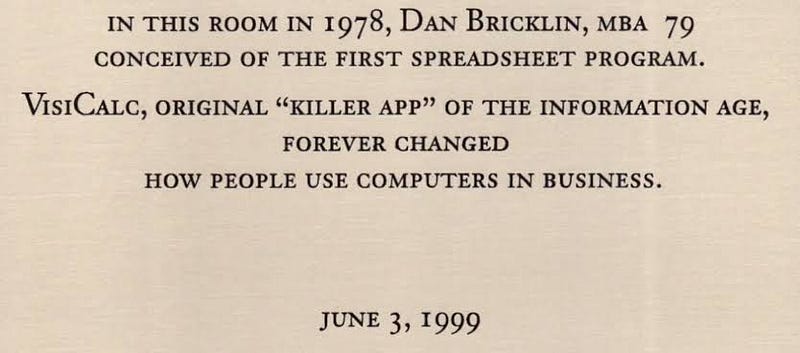
Read the verb. Changed. One room, one year, one product, all of it in the past tense. The plaque went up in 1999, and he has been going to work every day since — another twenty-seven years and counting.
Start with the afternoon it commemorates. Spring 1978, a first-year MBA student is daydreaming.
Business school runs on the case method, and you are expected to produce a number on the spot. What growth rate should this company use? Where should the margin land? You have a calculator and nothing else, and when the arithmetic gets away from you, you say a round number that sounds about right. The all-purpose answer was 10%.
He was daydreaming about something else. He wrote it down years later:
“Imagine if my calculator had a ball in its back, like a mouse…” (I had seen a mouse previously, I think in a demonstration at a conference by Doug Engelbart, and maybe the Alto). And “…imagine if I had a heads-up display, like in a fighter plane, where I could see the virtual image hanging in the air in front of me. I could move my mouse/keyboard calculator around on the table, punch in a few numbers, circle them to get a sum, do some calculations, and answer ‘10% will be fine!’” (10% was always the answer in those days when we couldn’t do very complicated calculations…)
Read that last parenthesis again. It is a joke at his own expense. Even in the fantasy, with the imaginary machine doing the work, the answer he gives is still the same round number everyone was bluffing with.
One action out of that passage survived: circle a group of numbers, then do something to them. The trackball went away. The heads-up display went away. Circling a group of numbers became the thing every person reading this has done today, selecting a range of cells.
That daydream usually gets counted as the origin of the electronic spreadsheet. What happened afterward is more interesting. He handed the thing to the world, then spent forty-seven years doing the same thing over and over.
At DEC, his first real product spared people from learning typesetting
Bricklin was born in 1951 and started programming in high school in the 1960s. He took a bachelor’s in electrical engineering and computer science at MIT in 1973, wrote a batch of interactive systems at the Laboratory for Computer Science, and met Bob Frankston there.
After MIT, he went to Digital Equipment Corporation, worked on computerized typesetting and editing hardware, and became project leader for WPS-8, one of the first standalone word processing systems.
That job is worth a second look. In the mid-1970s, word processing meant taking typesetting, a skilled trade, and handing it to a secretary who had never been trained in it. The first serious product of his career solved that kind of problem.
He left DEC in 1976 for FasFax, a small maker of microprocessor-based cash registers. In 1977 he went back to school, and in 1979 he took an MBA from Harvard.
From a bike path to October 8
The idea arrived in a classroom in the spring of 1978. The decision to build it came that summer, on a bike path on Martha’s Vineyard. By his own account, he was riding along and decided he wanted to turn this into a real product to sell after graduation.
The heads-up display went first, replaced by an ordinary screen. In the spring of 1978, he prototyped on the business school’s timesharing system in BASIC, and that is when the wish to place numbers, formula results, and text anywhere turned into rows and columns — because rows and columns give them names a human can read. The status line dates from the same sessions, showing the formula and formatting behind whatever value you are looking at.
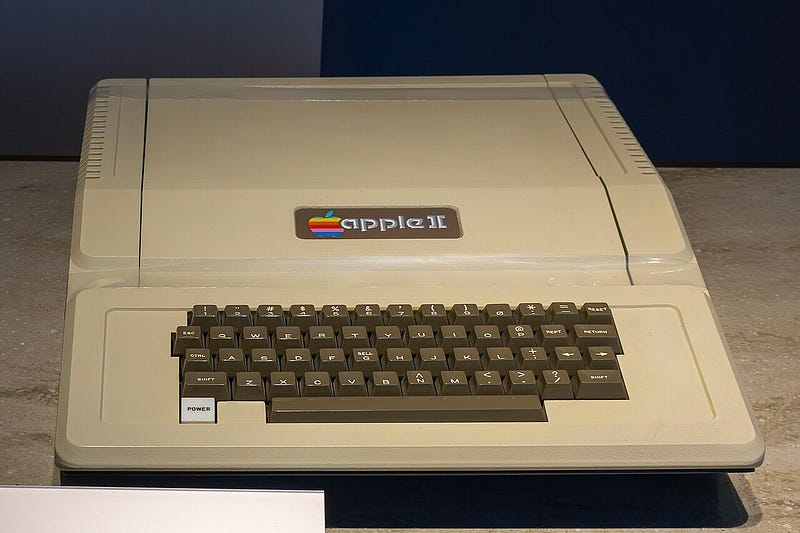
The mouse went next. The first personal computer prototype used the game paddle of the Apple II: turn the dial to move the cursor left and right, press the fire button, turn again to move up and down. The RC circuit in the Apple II was too sluggish and his pointing too imprecise to land the cursor accurately, so he switched to the keyboard. The Apple II had only two arrow keys, so he used the space bar to toggle between horizontal and vertical movement.
The Apple II was borrowed from Dan Fylstra, whose company Personal Software later became VisiCalc’s publisher. The prototype was written in Apple BASIC over a weekend. It could not scroll yet, but it had rows, columns, and arithmetic.
He kept a work journal, and the date is on it: October 8, 1978.
How did he design it? He drew state diagrams spelling out what happened when you pressed each key. One of them is on the back of a sheet of spreadsheet paper, so the blue row and column rules show through. It runs about 17 by 11 inches, which is why it had to be scanned in two pieces.
A one-in-ten shot
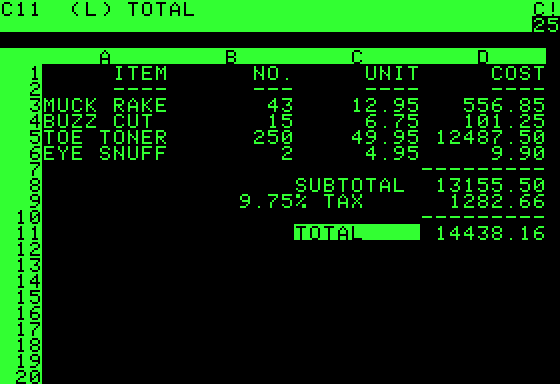
VisiCalc went public in 1979. Software Arts was founded the same year, with Bricklin as chairman through 1985.
BYTE magazine gave it a line in 1980 that carried real weight at the time:
“VisiCalc is the first program available on a microcomputer that has been responsible for sales of entire systems”
The first program people would buy a whole machine to run.
On the question of why they never patented it, the popular version is that he forgot, or did not know better. He wrote an essay explaining what happened, and the facts are more specific than that.
Personal Software, the publisher, retained a patent attorney who met with executives from both companies. The attorney explained how hard software patents were to obtain and put the odds of success at 10% — and that was with various techniques for hiding the fact that it was really software, such as proposing it as a machine.
“Given such advice, and the costs involved, we decided not to pursue a patent.”
They used copyright and trademark instead, and pursued both vigorously. In his own words, the enormous importance and value of the spreadsheet, and the need for protections beyond copyright to keep others from copying the work, did not become apparent for at least two years, too late to file.
The timing is painful. Two years after VisiCalc was shown publicly, the US Supreme Court held in Diamond v. Diehr that “a claim drawn to subject matter otherwise statutory does not become nonstatutory simply because it uses a mathematical formula, computer program, or digital computer.” That decision and others around it opened the floodgates for software patents. It came too late to help VisiCalc.
Worth adding, since his position on software patents is usually quoted at half length: he did say the software industry has other means of protection and incentive. He has real problems with how patents affect it, but the same passage ends with the line that they are the current law of the land, and he still applies for them at times.
In 1985, Software Arts was sold to Lotus. Bricklin was thirty-four.
A software company of one
He founded Software Garden the same year and made himself president. The company still exists.
Here he built Dan Bricklin’s Demo Program, a tool for prototyping and simulating other software. You could skip writing the real program and act out the interface and the interactions for people. It won the Software Publishers Association award for Best Programming Tool in 1986, and Demo II won it again in 1987.
In 1989, he shipped PageGarden, which handled repetitive printing on laser printers.
Betting on pen computing, closed in four years
In early 1990, Bricklin co-founded Slate Corporation with several PC industry veterans, took venture funding, and set up in Phoenix. He became vice president in 1992.
Slate bet on pen computing. It built application software for GO Corporation’s PenPoint, Microsoft’s Windows for Pen Computing, and the Apple Newton. Bricklin’s own product was At Hand, a pen-driven spreadsheet.
Pen computers did not sell. Slate ran for four years and closed. He went back to Software Garden.
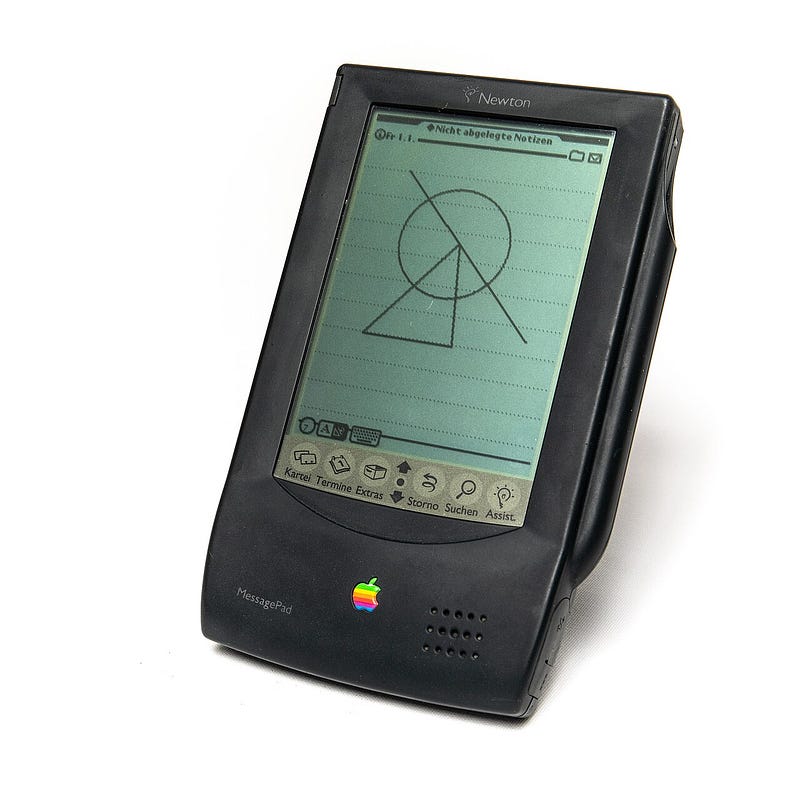
This is the cleanest failure of his career: right direction, early by a decade and a half. He referred back to it when he wrote about tablet PCs in the early 2000s, saying he had been heavily involved in the pen computing world.
Back at Software Garden, he built OverAll Viewer, a tool for displaying data visually, and demo-it!, the Windows version of the Demo Program.
Preinstalled on thirty-five million devices
In late 1995, he founded Trellix.
The capability being handed over this time was building a website. Trellix Web was a PC-based website creation tool, bundled on over 35 million devices from companies including HP, Dell, and Kodak. Later, Trellix Web Express moved to the server and was private-labeled by web communities and hosting services for small-business and personal sites.
In early 2003, Trellix was acquired by Interland, now Web.com. Bricklin became Interland’s CTO, working out of the old Trellix office through early 2004.
Then he went back to Software Garden. That was the third time.
An open-source spreadsheet, on a laptop built for children
Around 2005, he started wikiCalc, a spreadsheet-meets-wiki, released as open source.
It became SocialCalc: the Perl version developed by Software Garden for Socialtext, the JavaScript version rewritten by Bricklin himself, so an enterprise wiki could embed a collaborative spreadsheet directly instead of hosting a pile of separate spreadsheet files.
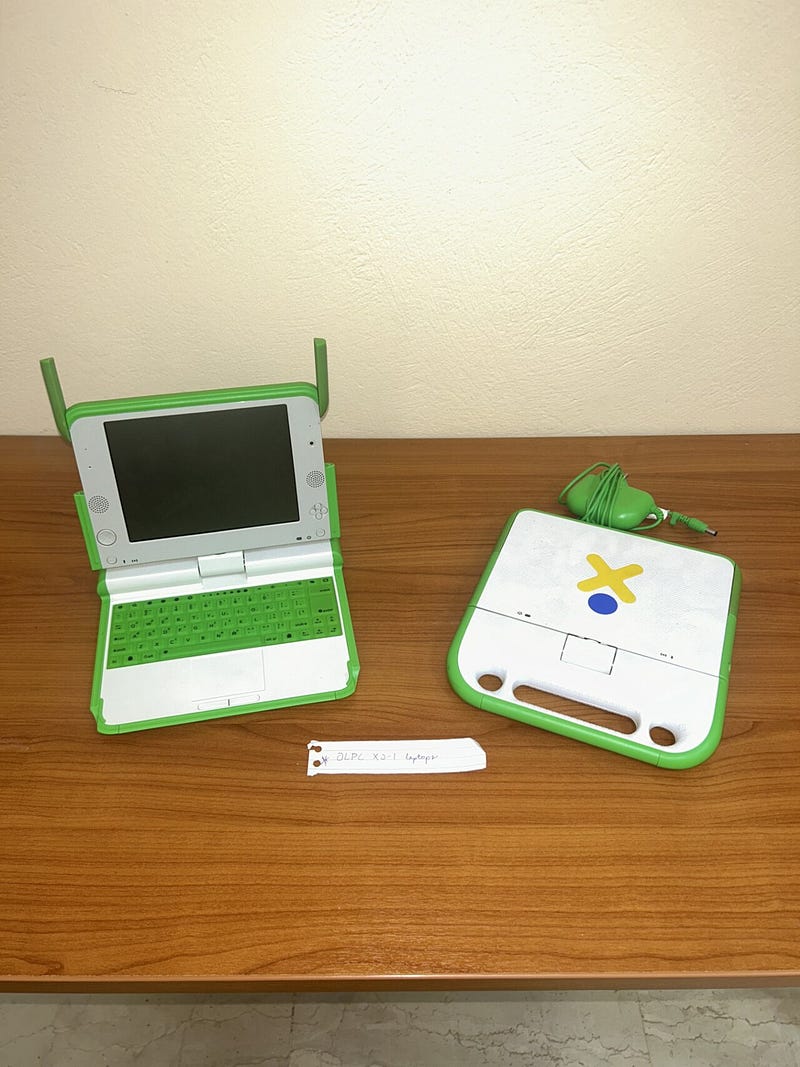
SocialCalc was then ported to the OLPC XO laptop as an open-source project. The hundred-dollar machine built for children in developing countries had no spreadsheet, and SocialCalc was small enough on both client and server to fill the gap.
The man who wrote the first commercial spreadsheet wrote a free one for a children’s machine twenty-eight years later.
After the iPad shipped, he wrote Note Taker HD for it, a handwriting app, still the most popular product Software Garden has. The electronic ink thread runs from Slate in 1990 straight through to here.
Sixty-two years old, and into low-code
On June 19, 2013, Alpha Software put out a release announcing Dan Bricklin as its CTO. He was sixty-two.
Alpha builds low-code and no-code tools. Alpha TransForm lets a business user turn a form into a mobile app; Alpha Anywhere lets developers quickly assemble enterprise web and mobile applications.
He is still in that seat, thirteen years on.
Lay the line out straight. Word processing spared secretaries from learning typesetting. VisiCalc let MBA students do the arithmetic without learning to program. The Demo Program let people demonstrate software without writing it. Trellix let ordinary people build websites. SocialCalc put a collaborative spreadsheet on a child’s laptop. Low-code lets business staff build their own apps.
Forty-seven years, six products, one idea.
His own biography puts it that throughout his career he has been creating products that explore new metaphors, sometimes with far-reaching consequences. That is the polite version. The blunter one is that he has spent his working life finding ways for people who do not write code to build something anyway.
The same idea
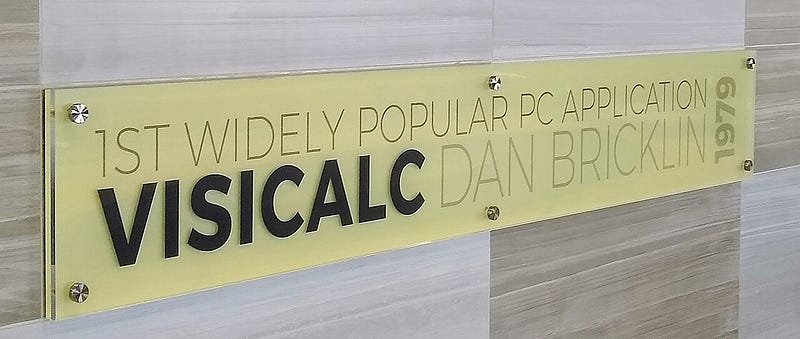
There is a widely repeated story about Bricklin: he invented the spreadsheet and never made money from it, failed to get a patent, and watched other people walk off with what should have been his.
The story does not hold up. He took the Grace Murray Hopper Award for VisiCalc in 1981, was elected an ACM Fellow in 1994, received the IEEE Computer Society’s Computer Entrepreneur Award in 1996, joined the National Academy of Engineering in 2003, and became a Computer History Museum Fellow in 2004. He founded four companies, sold two, served as CTO of a public company, wrote a book, and still works full time.
What deserves attention is not what he lost. It is that the thing he keeps doing has never changed.
The problem he wanted to solve on that afternoon in 1978 was concrete. Arithmetic was tedious, and changing one number meant recomputing the whole sheet. His answer was to make the sheet recompute itself.
Forty-eight years later, the problem has a different shape. I have a business process that needs to become an app, and I’m not a developer. He is still building the same kind of tool for the same kind of person.
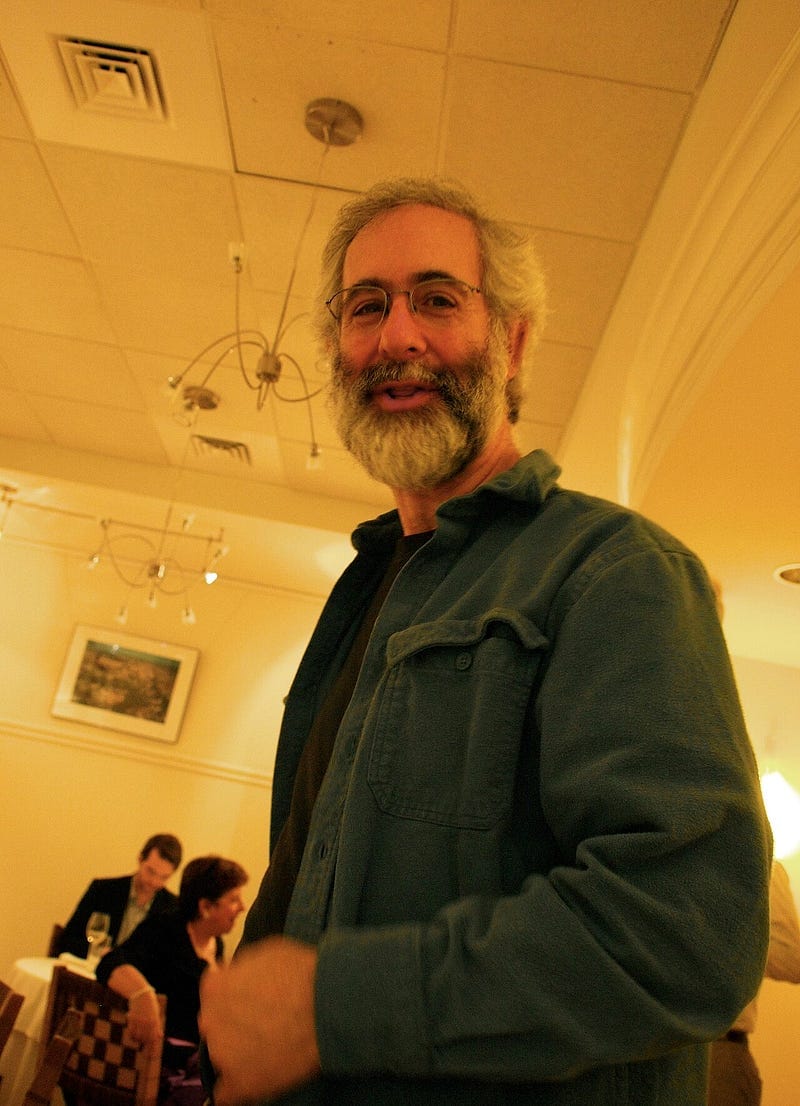
Dan Bricklin turned 75 on July 16 this year. He is still CTO of Alpha Software.