Bob Frankston Made VisiCalc Work — Then Spent Decades Removing Network Friction
Dan Bricklin had the spreadsheet idea — Frankston made it fit on an Apple II and reach ordinary users
IT HISTORY
Bob Frankston Made VisiCalc Work — Then Spent Decades Removing Network Friction
On August 13, I put Bob Frankston in one line of background when I wrote about VisiCalc. A reader called out the omission in the comments:
You mentioned Bob Frankston, but failed to discuss his importance to VisiCalc. Bricklin thought of the idea and did some prototype code, but Frankston was the person who actually made the idea work. He is one of the two genius programmers I have had the honor of meeting; the other is Richard Stallman. Shirley Márquez Dúlcey
That’s correct; VisiCalc is the work of both Dan Bricklin and Bob Frankston.
The VisiCalc story usually begins in Dan Bricklin’s accounting class. A professor erased one number on a blackboard, and the room had to recompute the rest. Bricklin wondered what would happen if the board recalculated by itself.
It was a memorable idea. It was not yet software a small business could run on an Apple II.
The narrow gate of the Apple II
In 1978, Bricklin borrowed an Apple II and built a BASIC prototype. It proved an electronic spreadsheet could work. It was not a product.
That fall, he brought in Frankston, another MIT alumnus. Frankston had worked part-time at Project MAC, worked with Fernando Corbató, and contributed to Multics. Multics was not the predecessor of Unix, but it strongly influenced Unix. The work taught engineers to handle limits and failure boundaries, not just build a convincing demo.
Bricklin and Frankston borrowed money for a Prime minicomputer. Frankston built the editor, assembler, and linker they needed, then rewrote VisiCalc in 6502 assembly.
Memory was the fight. The first target was 16 KB; the program ultimately needed 32 KB. That amount of memory wouldn't hold a phone photo today. On an Apple II, it determined whether a user could run the program at all.
This is Frankston’s place in the VisiCalc story. He turned an idea into a product people could put to work.
100,000 copies gave the Apple II a job
VisiCalc shipped in October 1979 and sold more than 100,000 copies within months. People bought Apple IIs for budgets and cash-flow forecasts. Change one number, and the page recalculated.
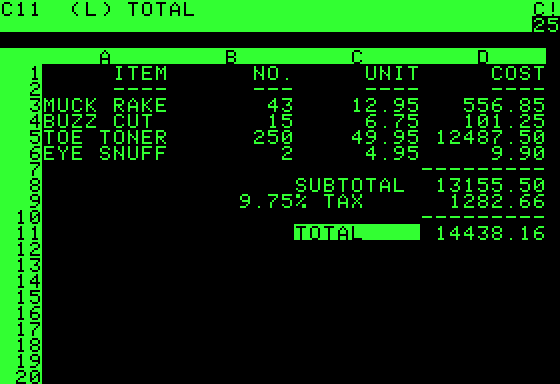
It became one of personal computing’s earliest killer apps. The label is usually told as a market story. Under it sits a plain engineering fact: software has to run on the machine the customer owns.
Bricklin saw the value of automatic recalculation. Frankston delivered it.
Lotus bought the company it had beaten
VisiCalc did not win in the end. Lotus 1–2–3 took the market with more features and faster iteration, while Software Arts’ finances deteriorated.
In April 1985, Lotus acquired Software Arts for $800,000 in cash and assumed $2.2 million in debt. The company buying VisiCalc was the same one that had pushed it out of the market.
Frankston joined Lotus with the acquisition and stayed until 1990. He worked on Lotus Express and added fax support to Lotus Notes. The spreadsheet was gone, but his work was shifting toward another question: how does information move from one machine to another?
It is tempting to call this a post-failure career pivot. I see the same engineering judgment in a new setting. VisiCalc gave computing power to people who did not write programs. His work at Lotus and later Microsoft moved toward giving communication to people who did not understand networks.
A home network should not charge by device
From 1993 to 1998, Frankston worked at Microsoft on Internet integration and home networking. Many access providers charged for each device’s IP address. Sharing one connection across several machines was not the default people now assume.
Frankston pushed a simple direction: adding another machine at home should not mean another connection fee. Home routers and NAT later made shared access feel ordinary, which makes the older per-device model hard to picture.
There was no grand invention in that choice. It was an engineering decision about what a user should not need to know.
Nobody should have to understand IP addresses, leases, and provider plans before connecting a second computer at home. Remove the gate, and the system becomes part of daily life.
Treat connectivity like a utility
Frankston later spent years writing about ambient connectivity. His definition was brief:
One such opportunity I call ambient connectivity — the ability to assume connectivity.
The important word is not ubiquitous. It is assumed. You notice an outlet or a water tap when it breaks; you should not have to negotiate access every time you use it.
Frankston was blunt about the role of traditional telecom operators:
All they do is help packets mosey along.
That is not a technical definition. It is a position. Network value should not belong only to the people who control the entrance.
His writing has a familiar impatience with turning basic connectivity into scarcity through layers of permission and fees.
The same problem, decades apart
From VisiCalc to home networking, Frankston appears to have moved from software to networks. Between them came the Lotus acquisition, Microsoft projects, and several turns in personal computing.
The underlying job remained consistent: hide the complexity behind the tool. Do not make an ordinary person learn a new language before doing something that should already work.
In 1979, Frankston faced an Apple II with only a few dozen kilobytes of memory. Decades later, he argued over whether a network connection should simply be available.
One problem let ordinary people calculate on a computer. The other is still not fully solved.
Sources
- Dan Bricklin — The First Product
- Computer History Museum — Bob Frankston
- Bob Frankston — Ambient Connectivity
- Frankston — The Internet and My 53 Years Online
Support writers. All our nonprofit’s offerings here.
Click here to subscribe to the IT Chronicles newsletter.
Click for Wordsmith, Mystery Writing, Write Like Stephen King, more
By the EIC Susan Brearley with Ideogram