AI Can Answer Anything So What’s Left For You?
The bottleneck shifted from finding information to asking the right questions — and judging which answers matter.
THINK
AI Can Answer Anything So What’s Left For You?
Here is a friends’ link to read for free if you are not yet a Medium member.
AI can answer. Only humans know what’s worth asking. AI can generate 100 answers. Only humans can tell which one actually matters.
This comes down to three things.
From Finding Answers to Asking the Right Questions
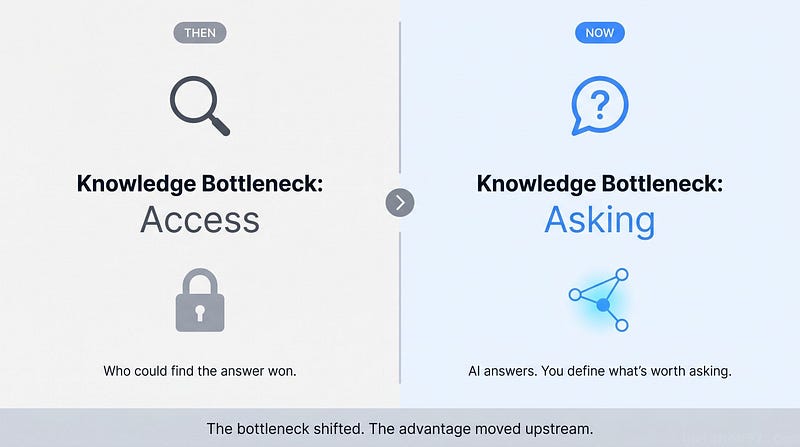
For most of history, the bottleneck was access. Whoever could find the answer had the advantage. Search engines started eroding that edge. AI has nearly eliminated it.
Ask GPT anything with a definitive answer, and you’ll get it back in seconds. But it won’t ask the question first.
That’s the shift.
A good question isn’t just a search query. It’s a signal of judgment — the ability to scan a sea of information and recognize what’s worth exploring. It comes from understanding a domain deeply enough to see its contradictions. From experience that reveals what’s missing. From curiosity to care about the gap.
Consider two analysts looking at the same earnings report. AI can run the financial analysis, flag risk signals, and model trends for both. But the question “Is this growth real or manufactured?” — that comes from pattern recognition earned over the years. The question “Is this business model actually sustainable?” — that comes from industry intuition, no LLM trained on text can fully replicate.
AI waits to be asked.
The first competitive edge: whoever asks better questions controls the direction.
From Processing Information to Making Value Calls
AI’s answers are getting faster. They’re getting better. But whether an answer is right — whether it fits your specific context, your priorities, your constraints — that judgment still belongs to humans.
Not because AI isn’t smart enough. But because “good” is a subjective standard. It involves values, context, and stakes that exist outside the text.
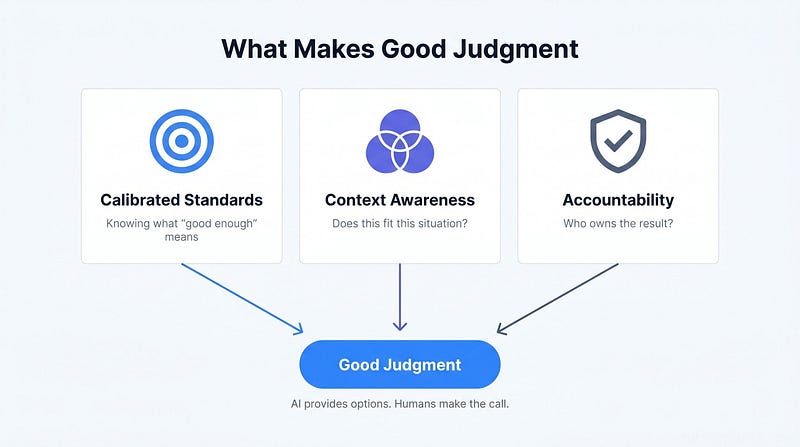
Good judgment requires two things:
A calibrated sense of standards. Knowing what “good enough” means. Knowing what you won’t accept. This comes from experience and a trained aesthetic — AI can assist, but can’t supply it.
Context awareness. The same answer comes across very differently depending on your team’s capacity, your company’s positioning, and your audience’s current mood. AI might understand the words. It doesn’t always understand your situation.
And there’s one more dimension: accountability. AI can generate recommendations. It won’t own the outcome. Decision-makers are always human.
Here’s a concrete example. AI can generate 10 versions of a tagline. It won’t tell you which one fits your brand’s personality, the current cultural moment, or your long-term positioning. That call is yours.
The second competitive edge: whoever makes better judgments on top of AI’s output holds the final decision.
antirez once wrote a very good blog.Human coders are still better than LLMs I recommend that you read it.
The Shift from Operator to Gatekeeper
Put these two together, and a larger pattern emerges:
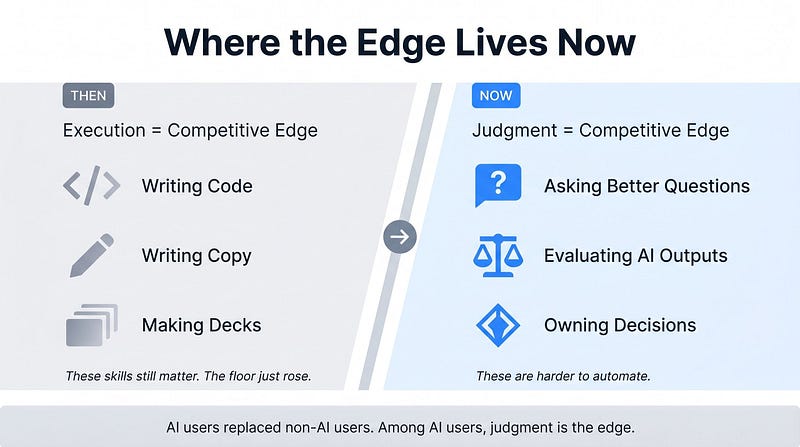
Human value is migrating from execution to decision-making.
Coding, writing, making decks — these were hard skills, competitive advantages. Now AI does them too. But the quality and direction of that output depends entirely on how you prompt it, evaluate it, and iterate on it.
The skills haven’t become worthless. The floor has just risen. The real moat is now:
- Can you turn a vague idea into a precise question?
- Can you read AI output and spot what’s wrong — and articulate why?
- Can you choose between viable options under uncertainty?
- Can you own the result?
AI users replaced non-AI users. But among AI users, the competition is about prompting and judging.
What This Actually Means
AI’s core advantage in this era isn’t competing with AI on answering questions. It’s:
- The ability to ask — identifying questions worth asking, scoping them clearly, pointing toward what matters
- The ability to judge — choosing from AI’s outputs, and standing behind the choice
Other skills still matter. Communication. Creativity. Execution. But in a world where AI can answer anything instantly, asking and judging are the most distinctly human — and hardest to replace.
Answering this question also answers another:
Do you want to be AI’s operator, or its driver?
If this resonated, I’d love to hear how you’re thinking about your own edge in the AI era — drop a response below.
Support writers. All our non-profit’s offerings here.
Click here to subscribe to the IT Chronicles newsletter.
Click for Wordsmith, Mystery Writing, Write Like Stephen King, more
By the EIC Susan Brearley with Ideogram