A Father’s Last Gift Became the Most Important University in Tech
Leland Stanford built a railroad empire — then his only son died and he decided to build something that would outlast them both.
IT HISTORY
A Father’s Last Gift Became the Most Important University in Tech
Silicon Valley has a brain, and it sits on an old horse farm in Palo Alto. For more than a century, the people, patents, and companies that run the tech industry — Google, Cisco, Sun, Yahoo, LinkedIn, Instagram, and tens of thousands more — have come out of Stanford University. This is the story of how that brain got built, in five parts.
1. A Father’s Last Gift Became the Most Important University in Tech
2. The Widow Who Refused to Let Stanford Die
3. The Professor Who Invented Silicon Valley
4. The Garage, the Professor, and the Birth of HP
5. From a Nobel Prize to a Search Engine
On March 3, 1884, a fifteen-year-old boy died of typhoid in a hotel room in Florence, Italy. His name was Leland Stanford Junior, and he was the only child of one of the richest men in America.
His father — railroad tycoon, former governor of California, the man who had bent steel rails across an entire continent — shut himself in a Paris hotel room for five weeks and kept rewriting his will. When he finally came out, he told his wife something that would, a century later, help create Silicon Valley: the children of California would be their children.
He was sixty, his son was gone, and he had decided to build a university.
Bending a Continent
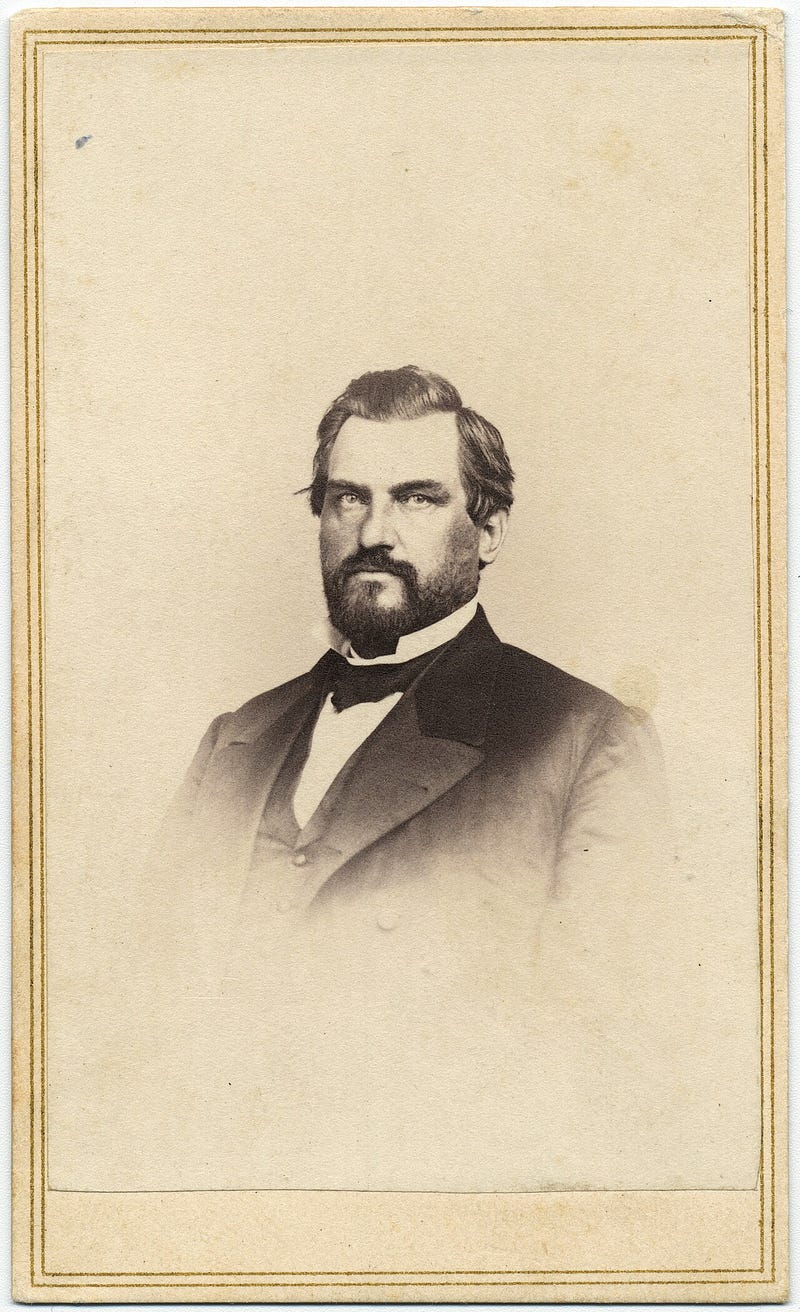
To understand what Stanford did next, you have to understand what he had already done.
Born in 1824 to a prosperous farming family in upstate New York, Stanford practiced law in Wisconsin before heading west at twenty-eight. California in the 1850s was raw, violent, and flush with gold-rush money, and Stanford saw that the surest fortunes were being made not in the mines but in supplying and moving the men who worked them.
He became one of California’s “Big Four,” the quartet of businessmen who controlled the western half of the Transcontinental Railroad. As president of the Central Pacific Railroad Company, he drove track eastward from Sacramento while the Union Pacific drove westward from Omaha, and the government had made the incentive brutally simple: whoever laid more track claimed more land. Stanford laid it fast.
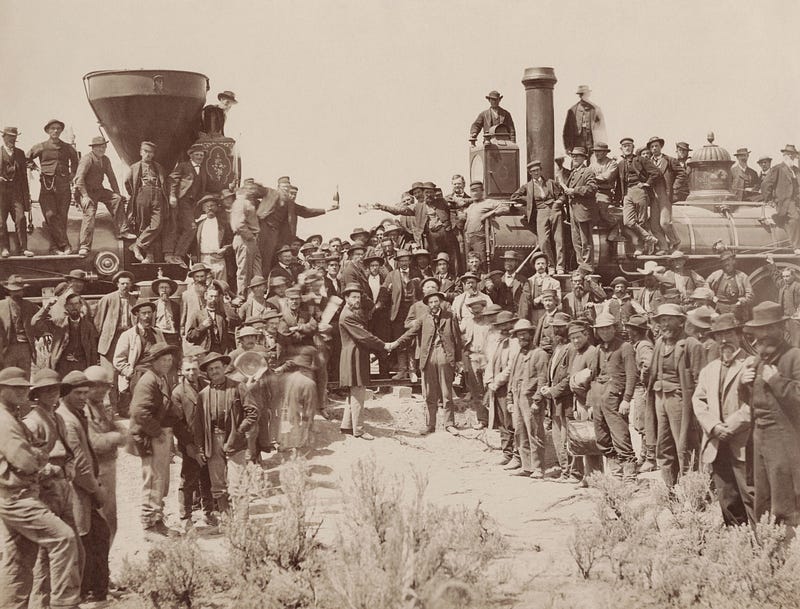
On May 10, 1869, at Promontory Summit, Utah, Stanford swung a silver hammer at a golden spike, and the two rail lines met. For the first time, a single continuous track ran from the Atlantic to the Pacific, and the United States became a transcontinental nation overnight. The wealth that followed was almost beyond counting.
Stanford turned some of it into politics, serving as California’s eighth governor from 1862 to 1863 — the state’s first Republican to hold the office. He assembled more than 8,000 acres of farmland in the Santa Clara Valley, a sleepy stretch of orchards and ranches south of San Francisco, and built mansions in Sacramento and San Francisco. For decades his life was a straight line of accumulation: more money, more land, more power. And at the center of it all was the boy.
Heir to an Empire
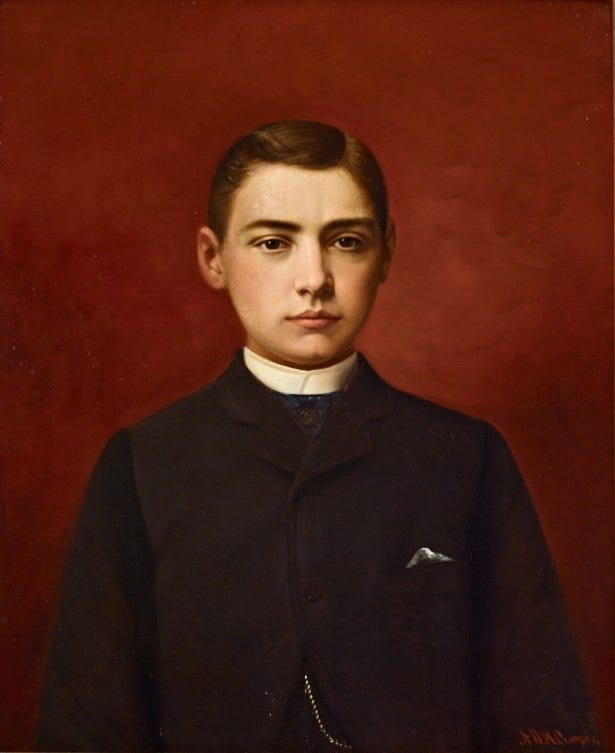
Leland Stanford Junior was born in 1868, when his father was forty-four and his mother Jane thirty-nine. As their only child, he was the center of their world.
The Stanfords gave him everything the nineteenth century could offer a privileged child. He studied in New York while preparing for Harvard, and each year the family toured Europe together — London, Paris, Rome — collecting art and experiences and building a life for the son who would one day inherit an empire.
In November 1883, the three of them set out on another European journey. They passed through Athens, sailed to Naples, spent New Year’s in Italy, and reached Florence early in 1884. There, the boy developed a fever that kept climbing and would not break.
The diagnosis was typhoid. Stanford summoned the best doctors from Paris, and they tried every available treatment, but none worked. Leland Stanford Junior died on March 3, 1884. Six days later, his father turned sixty.
Five Weeks in a Paris Hotel Room
What happens inside a man who loses his only child, six days before his sixtieth birthday, in a foreign country, with all his money unable to save anyone? For five weeks in Paris, Stanford barely left his room, working on the will that would decide where his fortune would go now that there was no son to receive it.
The story, as it has come down, involves former President Ulysses S. Grant. Grant and his wife visited the Stanfords during the mourning and introduced them to a friend, a Madame Medereck, whose conversations planted an idea — that the Stanford fortune might build something to outlast any single life.
The first plan was modest: a technical school, a practical institution perhaps affiliated with the University of California. But when Stanford was nominated to the UC Board of Regents, political opponents in the state legislature blocked his appointment. His response was pure railroad man. Fine — he would build his own.
The Founding Grant, November 11, 1885
On November 11, 1885, Leland and Jane Stanford signed the Founding Grant of the Leland Stanford Junior University.
They donated 8,180 acres of Palo Alto farmland — the entire Palo Alto Stock Farm, where they had once bred champion racehorses — and added $2.5 million in cash, roughly $80 million today.
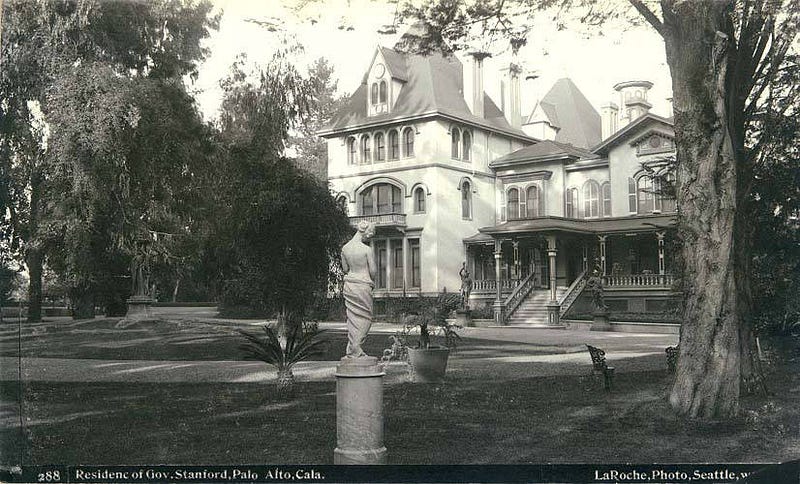
Stanford residence, Palo Alto Stock Farm, ca. 1888. Frank La Roche, Public domain, via Wikimedia Commons.
The money mattered less than the conditions attached to it, and the grant set out four.
Its stated object was, in the grant’s own words, “to qualify its students for personal success, and direct usefulness in life” — a deliberate turn away from the liberal-arts-for-their-own-sake model that dominated American higher education. It also had to be non-sectarian: the grant prohibited sectarian instruction and forbade any tie to a specific denomination, even as it directed the school to teach “the immortality of the soul” and the duty of obedience to an “all-wise and benevolent Creator.” Stanford was a religious man who did not want his university to become a church.
The third condition was radical for 1885. Men and women had to be admitted on equal terms, at a time when coeducation was nearly unheard of at major American institutions, and Stanford insisted on it. The fourth was almost sentimental: the university would keep a working farm, a standing reminder that in Stanford’s view knowledge grew from the ground up.
He spent the next six years building it. Frederick Law Olmsted, who had designed Central Park, laid out the campus plan; MIT president Francis Amasa Walker advised on how the new university should be organized; and the Boston firm Shepley, Rutan & Coolidge turned the vision into buildings. Stanford reviewed the plans himself, demanding an architecture that answered to California — sandstone arches, red-tile roofs, open courtyards under a blue sky.
Opening Day, October 1, 1891
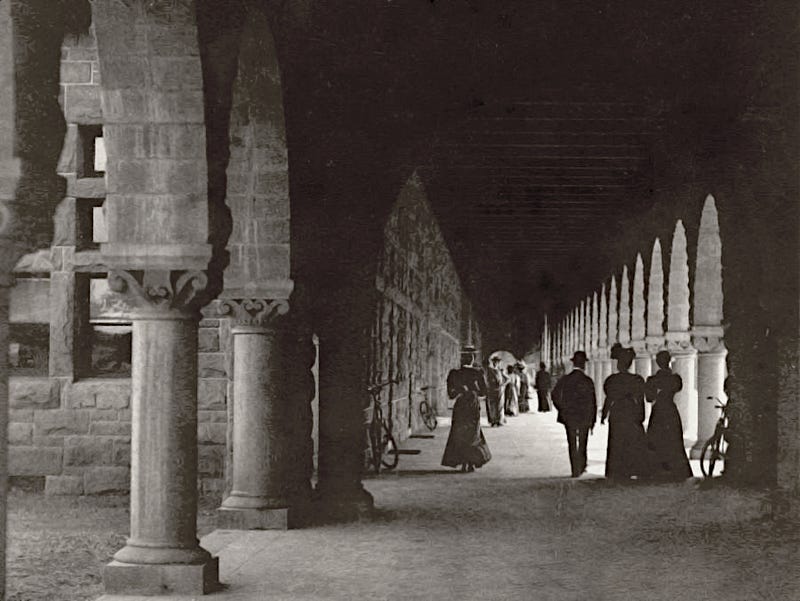
Stanford University, 1891 — its inaugural year. O. V. Lange, Public domain, via Wikimedia Commons.
On October 1, 1891, the university opened its doors.
Five hundred and fifty-five students enrolled that first year. They arrived by train at the new Palo Alto station, walked past orchards still heavy with fruit, and entered a campus that looked like nothing else in American education — a California mission reimagined for the industrial age. The curriculum was just as unusual: twenty-five departments to choose from, everything elective except English. Stanford wanted his students literate, and beyond that he trusted them to find their own way.
The Founding Grant had already fixed the university’s purpose in plain terms — personal success and direct usefulness in life — and at the opening ceremony the sixty-seven-year-old founder told the first class that the school existed for exactly that: to prepare them for useful, practical careers rather than for learning as an ornament. Read that ambition through a modern lens and four words fall out of it: innovation, enterprise, design, execution. They were not the priorities American university presidents talked about in 1891. They were the instincts of a businessman who had built a railroad, and they would become Silicon Valley’s operating system.
The Cliff
Leland Stanford did not live to see what his university would become. On June 21, 1893, less than two years after opening day, he died of a heart attack at sixty-nine, and under the revised will he had drafted in that Paris hotel room, his entire estate went to the university.
His timing could hardly have been worse. The Panic of 1893 had just begun, the worst American depression before the 1930s, and it took down banks and railroads across the country. The Stanford fortune, tied up in railroad stocks and land, was frozen by court order, leaving the university suddenly without access to its own money.
Most of the trustees recommended the obvious course — close the doors, wait for better times, protect what remained. Jane Stanford refused. How one widow, living on $350 a year while she lobbied presidents and Congress, kept the university alive against every force telling her to quit is the subject of the next piece in this series.
Every venture-backed startup in a Palo Alto garage, every Stanford PhD who built a billion-dollar company, every chip and line of code that traces back to the university on the old stock farm — all of it runs back to a sixty-year-old man in a Paris hotel room, rewriting his will, looking for something to do with his grief. He found it.
Coming next in this series: “The Widow Who Refused to Let Stanford Die” — how Jane Stanford saved the university that her husband built.
Support writers. All our non-profit’s offerings here.
Click here to subscribe to the IT Chronicles newsletter.
Click for Wordsmith, Mystery Writing, Write Like Stephen King, more
By the EIC Susan Brearley with Ideogram